




























The next era of policymaking: From reactive cycles to dynamic systems

By Dima Sayess, Fatima Koaik, Melissa Rizk, and Ana Pimienta
June 2026
5 minute read
Share
background
In its most basic form, policymaking responds to societal challenges as they emerge. With strong strategic intent, policy shapes individual and organizational behavior and aligns government action. At its most impactful, policy leaves a lasting legacy – influencing societal outcomes and improving citizens’ quality of life over decades.
Yet today, policymakers are being asked to achieve these things in environments that are more complex, uncertain, and fast-changing than ever before. Traditional approaches to the policy cycle – often linear, slow-moving, and reliant on static assumptions – can limit how effectively policy responds to emerging needs, shifting behaviors, and unexpected disruptions.                               
                              
                              
What if policymakers could sense change before it emerges, learn from how people actually behave, and adapt in real time?
                              
Big data is making the difference, powering predictive foresight, behavioral insight, and collective intelligence to redefine the realm of what is possible, and enabling governments to sense change before it happens, test interventions, and learn from real-world outcomes in near real time. This makes possible not only better policy design, but also continuous refinement – moving from one-time decisions to adaptive systems that evolve alongside the societies they serve.
This moment calls for an evolution in how we understand policymaking. We need to build on existing foundations as new capabilities allow governments to operate effectively and thrive in an interconnected and dynamic world.                               
                              
                              
Six trends disrupting policymaking
                                    
Policymakers are already responding to increasingly complex, dynamic, and interconnected challenges by moving beyond traditional policy approaches and toward models that are more anticipatory, personalized, iterative, immediate, adaptive, and networked.                                     

                                    1. From reactive to anticipatory                                     
                                    
                                                                                     Policy often lags behind fast-evolving societal needs, reacting only to immediate pressures.                                     


                                                                                     Anticipatory policymaking uses foresight and predictive analytics to detect disruptions early and trigger timely analysis.                                     


                                    2. From one-size-fits-all to personalized delivery                                     
                                    
                                                                                     Traditional policy approaches imagine an "average" citizen, often overlooking diverse needs and lived realities.                                     


                                                                                     Personalized and context-aware policy delivery tailors interventions to individuals and communities, improving relevance and equity.                                     


                                    3. From linear rollout to iterative sandboxing                                     
                                    
                                                                                     Linear policymaking assumes a predictable path to scale and generates learning only after implementation.                                     


                                                                                     Iterative policy sandboxing enables prototyping, testing, and refinement before policies scale, reducing risks.                                     


                                    4. From static evidence to real-time intelligence                                     
                                    
                                                                                     Evidence has often been static and retrospective, based on periodic reports and lagging indicators.                                     


                                                                                     Real-time intelligence powered by live data and analytics enables proactive decision-making and course correction.                                     


                                    5. From fixed reviews to adaptive policy systems                                     
                                    
                                                                                     Fixed review cycles have struggled to keep pace with fast-changing realities.                                     


                                                                                     Adaptive policy systems embed continuous feedback across every stage of the policy cycle, leading to faster adaptation.                                     


                                    6. From siloed to networked governance                                     
                                    
                                                                                     Siloed policymaking limits coordination on cross-cutting challenges.                                     


                                                                                     Networked governance mobilizes government, the private sector, academia, and citizens, driving collective action.                                     


What this means for the policy life cycle
                                    
An important question is whether these new approaches fundamentally alter the policy cycle.
                                    
The answer is not quite.
                                    
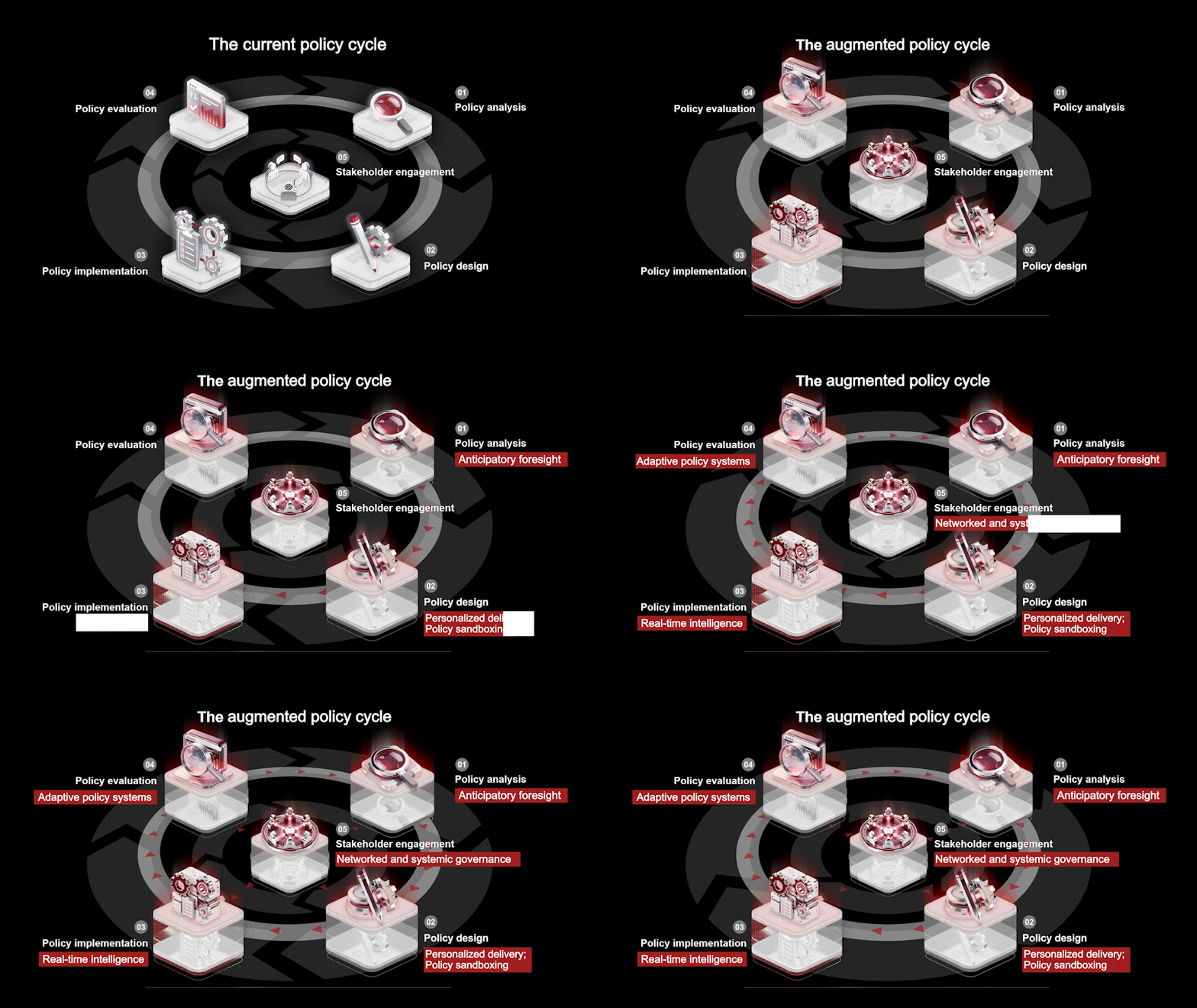
Traditionally, policymaking has been understood as a sequential process. In the usual process, issues are identified and placed on the agenda. Policies are then designed, adopted, and implemented before outcomes are evaluated for effectiveness and efficiency, informing amendment or termination.
                                    
Although this sequence is unlikely to change, the way policymakers engage with each stage is fundamentally evolving.
                                    
These shifts do not replace the policy cycle. Instead, they augment it – expanding how each stage is triggered, informed, and executed – transforming a linear workflow into a living, adaptive system.


background
Rewiring the policy engine.
                         
Conclusion
                                    
Building the capabilities this future requires
As governments embrace these trends and move from being reactive problem-solvers to actively shaping the system, a key question emerges: how to sustain the shift? This evolution requires ongoing investment in both human and system capabilities, which together form the foundation of a living, intelligence-driven policymaking ecosystem.
Skills for the living policy era
Policymakers need new skills: anticipatory thinking to spot emerging trends, behavioral insight to understand how people actually behave, systems mapping to decode interdependencies, data literacy to leverage real-time intelligence, experimental design to test solutions, and cross-sector collaboration to mobilize ecosystems.
Building these capabilities requires targeted training, multidisciplinary teams, new talent pipelines, and an institutional culture that values innovation, agility, experimentation, and adaptive decision-making.
The system infrastructure that enables it
Governments must build the enabling infrastructure for modern policymaking: interoperable data ecosystems, real-time intelligence platforms, policy sandboxing environments, impact simulators and digital twins, and governance architectures that allow seamless collaboration across ministries, sectors, and society.
These systems let institutions sense change early, test options safely, evaluate impacts continually, and adjust policies dynamically as conditions evolve.
                                    
                              
The Ideation Center Policy Intelligence Suite


Foresight radar
                              
                                    A digital strategic tool designed to monitor, visualize, and analyze emerging trends, signals, and potential disruptions enabling proactive decision-making.                               


Risk register
                              
                                    A strategic tool that identifies, evaluates, and tracks risks, along with their mitigation plans, to enhance policy resilience.                               


Policy bot
                              
                                    AI-powered engine that automates policy research, and benchmarking, combining expert reasoning with machine precision to accelerate evidence-based policymaking.                               


Policy pulse
                              
                                    A real-time intelligence tool designed to measure visibility, resonance, and the responsiveness of government policies to public discourse.                               


Experimenta
                              
                                    An online experimentation tool kit designed to help policymakers rapidly generate empirical, actionable evidence through modular behavioral trials.                               


Impact simulator
                              
                                    A data-driven modeling tool that quantifies how policy actions influence performance pillars and socioeconomic outcomes.                               


AI-enabled system compass
                              
                                    Dynamic, evidence-backed decision tools that transform static diagrams into interactive platforms, allowing policymakers to visualize interconnections, run scenario simulations, and query results in real time.                               


Rapid impact assessment tool
                              
                                    A fast, evidence-based tool for ex ante and ex post evaluations that estimates the economic and social impacts of policy interventions.                               


Value-for-money tool
                              
                                    A cost-benefit tool that measures the efficiency and effectiveness of public spending by linking policy costs with anticipated returns.                               


Social network analysis
                              
                                    A process of mapping and measuring relationships, connections, and interactions within a network – such as individuals, organizations, or systems – to uncover patterns of influence, information flow, and collaboration.                               


Sentiment analysis
                              
                                    The process of using AI and language models to analyze textual data and classify sentiment, providing an overall pulse of public opinion.                               


On a mission?

We'd love to hear from you, whether it's a project, partnership opportunity, or an idea.

Required fields are marked with an asterisk(*)

By submitting your email address, you acknowledge that you have read the Privacy Statement and that you consent to our processing data in accordance with the Privacy Statement (including international transfers). If you change your mind at any time about wishing to receive the information from us, you can send us an email message using the Contact Us page.