








{{item.videoDuration}}
{{item.title}}

{{item.videoDuration}}

A holistic and tailored approach to feeding a growing global population
Food security is a critical and increasingly complex policy priority for governments worldwide, involving deep-rooted, systemic challenges across global and national food systems. Population growth, geopolitical risks, trade fragility, technology, and climate change are intensifying these challenges. But food security is a multifaceted topic. Targeted initiatives, if not fully thought out, can have unexpected consequences—improving performance in one aspect of the food system while unintentionally worsening performance in others.
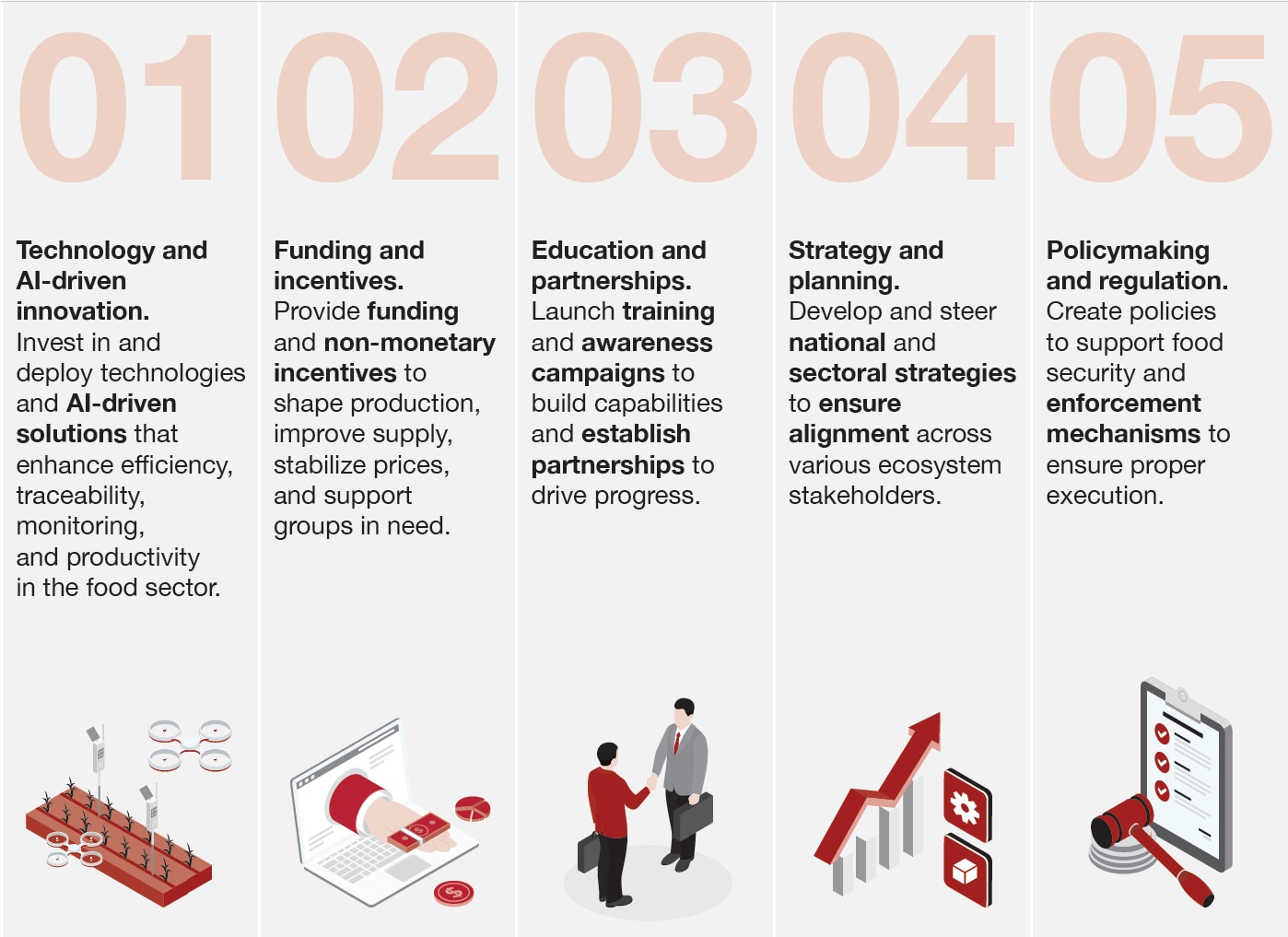
Governments need a comprehensive approach that addresses the four pillars of food security: availability, affordability, safety and quality, and sustainability. Policymakers have a variety of tools they can use, including regulatory policies, funding, education, and technology. By starting with a clear understanding of their current situation and greatest needs, governments can choose the right set of tools for their unique context, ensuring that they can meet the food needs of their citizens and the rest of the world.
Although the current situation remains fluid and the effects are still unfolding, recent events reinforce a broader lesson: Food security resilience increasingly depends not only on domestic production, but also on diversified sourcing, flexible logistics, and shock-ready policy design.
There is no one-size-fits-all approach to accomplishing the food security balance across the globe’s different geographies and food security archetypes. Each country must understand its own greatest needs and priorities, learn the lessons of the past, and use the applicable levers from the tool kit discussed above.
The right approach addresses both demand and supply. Demand can be addressed through education and by embedding meal programs into other government support. Supply can be addressed through subsidies, incentives, and investment in technology, among other measures. Moreover, governments don’t have to tackle this issue alone. There is a huge role for the private sector, via properly structured partnerships that mitigate risks, especially in the earlier phase of initiatives.
Through this type of coordinated, comprehensive, and regionally specific approach, countries can create a more food-secure world.
This article originally published in Arabian Business, May 2026.
Food security and the future of agrifood systems – Interview with Roger Rabbat
Food security is becoming an increasingly urgent global priority amid supply chain disruptions, climate pressures, and rising demand. In an interview with Al Arabiya, Roger Rabbat discusses how governments can strengthen food resilience through smarter policies, agritech innovation, and more sustainable food systems.







Menu