







Power without borders
Unlocking the next frontier of the energy transition
Introduction
The global energy transition has reached a major turning point. Renewables are scaling rapidly, reshaping markets, investment patterns, and the architecture of global power systems. Indeed, 585 gigawatts (GW) of new capacity was added in 2024 alone, accounting for nearly 93 percent of all new generation.
Yet, paradoxically, the more the world builds, the more energy remains stranded. Thousands of gigawatts of clean electricity are now curtailed (that is, intentionally reduced) each year for lack of transmission. Germany curtailed 1,389 gigawatt-hours (GWh) of solar power in 2024—enough to supply 400,000 homes, based on our analysis. Similar waste occurs in China’s northwest, California’s Central Valley, and Saudi Arabia’s deserts.
This mismatch between renewable generation growth and transmission capacity has become the defining constraint of the energy transition. Whether the next stage of decarbonization succeeds will depend less on how much renewable capacity is installed than on how effectively nations connect it to demand.
Electricity trade across borders—power without borders—offers one solution. It links surplus with scarcity, balances renewable intermittency across time zones, and turns stranded generation into tradable value. This solution can resolve a part of the cross-border energy imbalance while complementing other, more focused, solutions, such as locating energy-intensive industries closer to renewable energy sources.
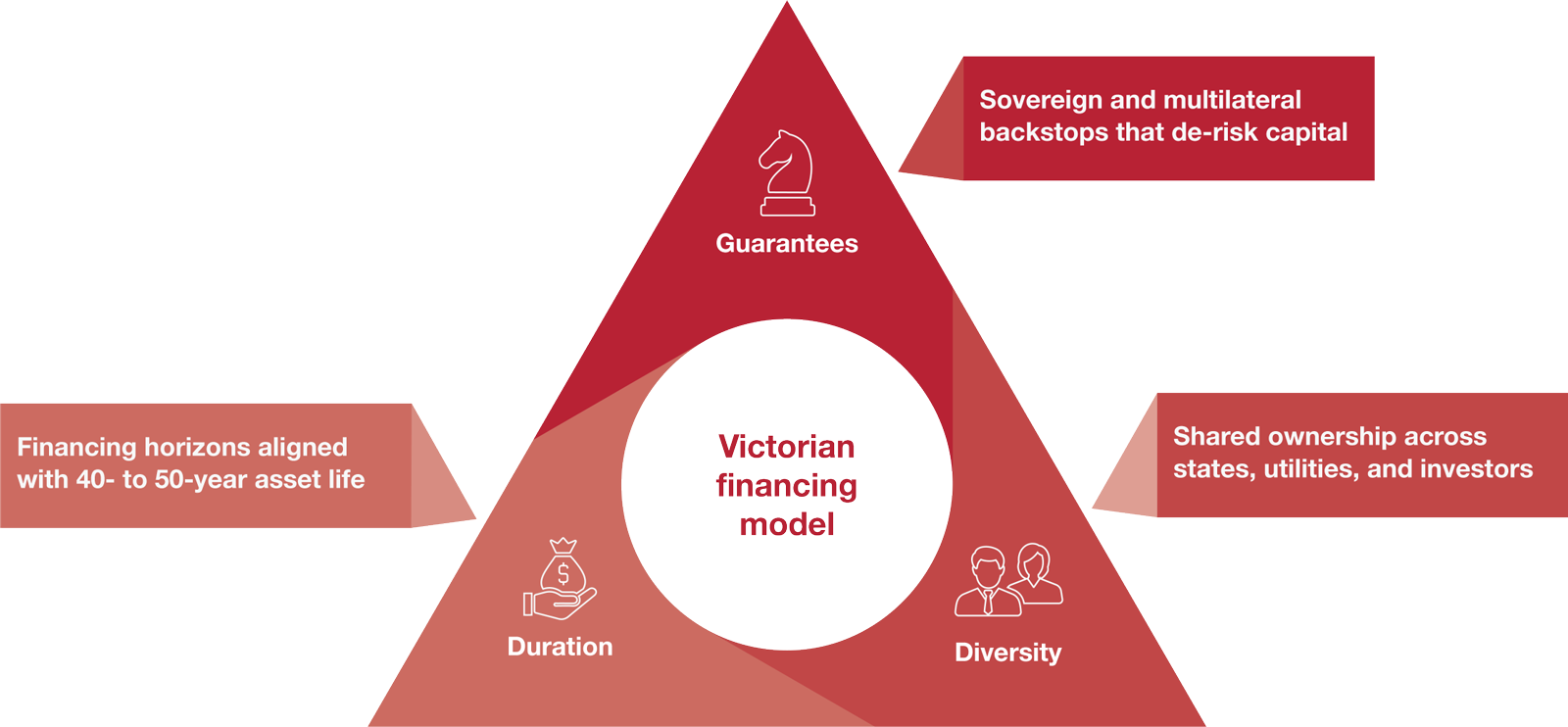
The modern Victorian financing model
Projects become investable when these three conditions reinforce one another
Source: Strategy&
These links could redefine energy geopolitics if policy and financing align. Solar power from the deserts of Arabia could supply regional or European demand; hydropower from central Africa could stabilize southern grids; and Asian interconnections could underpin the region’s manufacturing expansion.
Realizing this vision will require more than technology. Conventional project finance was not designed for multi-country, multi-decade infrastructure of this scale. Cross-border power exports will require financing models that combine sovereign backing, long-term horizons, and shared risk—in essence, a form of “Victorian financing” adapted to the realities of today’s energy transition. The Middle East and North Africa (MENA) region is uniquely positioned to conduct pilots for this model and could be at the vanguard of a cross-border energy revolution.
Conclusion
The industrial world was built when financial engineering caught up with technical ambition. Today’s decarbonization challenge demands the same creativity. Victorian finance built the railways of industry; its reinvention can contribute to building the cables of decarbonization.
By pioneering the modern Victorian financing model, the MENA region can define the global standard for financing, governing, and operating the infrastructure of the cross-border energy transition. The region already holds the ingredients—low-cost renewables, sovereign capital, and strategic geographic location—needed to pioneer it.
Beyond the economic benefits, power exports can anchor a new era of regional cooperation and soft power. Interconnectors replace vulnerability with interdependence by tying national ambitions to shared prosperity. In the process, the MENA region could move from energy supplier of the past to energy integrator of the future, shaping how electrons, not hydrocarbons, power global trade.
The region has the sunlight, the capital, and the conviction. What remains is to connect them.
Power without borders
Unlocking the next frontier of the energy transition
Contact us









Menu