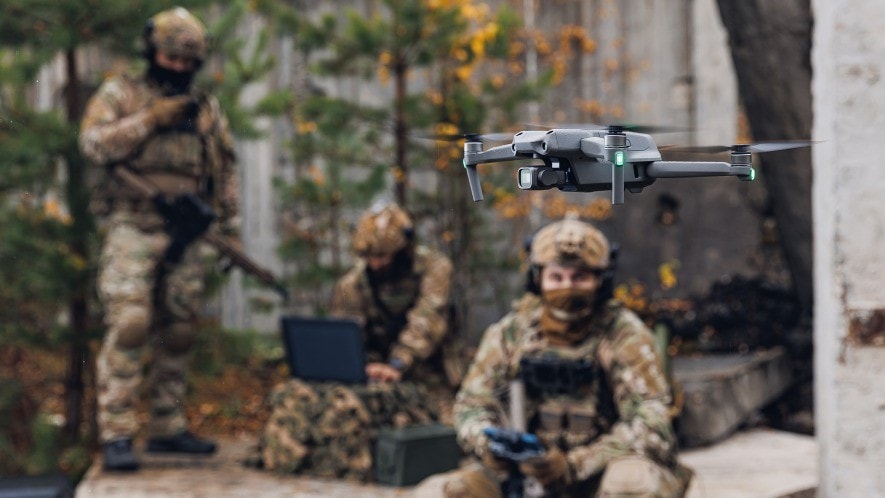
The European defence sector is undergoing a technological shift with historic consequences. As NATO countries move towards defence budgets of up to 3.5% of GDP, it is C4ISR – Command & Control, Communication, Computing & decision‑support, and Intelligence, Surveillance and Reconnaissance – that is growing the fastest and transforming the entire market structure.
C4ISR grows more than twice as fast as the rest of the defence budget – a development that could create new power shifts in Europe.
Our report shows that the C4ISR market is growing by 15–17% annually, more than twice the overall growth rate of defence spending. In practice, this means a shift from heavy, costly platforms towards technologies that provide real-time information, rapid decision loops, and autonomous capabilities.
This development could alter the balance of power within Europe – a clear point of conflict that will become central in NATO discussions in the years ahead.
Our Strategy& team has conducted a comprehensive mapping identifying around 100 Nordic C4ISR actors, many technologically leading but without sufficient scale to independently secure large NATO contracts. This is the first time such a complete overview has been published.
– What were previously support functions are now at the very core of operational capability. The ability to sense, understand and act faster than the adversary will determine the conflicts of the future.
Nordic forces becoming strategically important for NATO
Nordic defence communities have decades of experience operating in Arctic, maritime, and GPS-degraded environments – operational conditions now high priorities for NATO. This gives Nordic suppliers structural advantages.
Systems designed for extreme environments
Strong technology clusters in telecom, maritime industry, and cybersecurity
Concentrated specialists with dual-use expertise
For Norwegian and Nordic companies, this presents a unique market opportunity – while allies increasingly demand secure, European technologies.
Market opens up: From monoliths to modular ecosystems
The report documents a shift from closed national systems to open, modular NATO-standardized architectures. This enables more actors to compete and contribute within the same value chain, reducing the dominance of a few large integrators. This represents one of the largest structural changes in the European defence industry in decades.
Five strategic opportunities highlighted in the report:
Develop a European platform for data integration and AI-driven decision support
Consolidate Nordic communications providers into a common NATO-capable actor
Build a new European infrastructure for secure communication
Create a leading maritime ISR platform in the Nordics
Develop modular C2 and BMS solutions for future NATO architectures
For the full analysis, download Strategy&’s report The Rise of Defence Technology.
Download our insights
Fill out the form and you will receive a link to download the report.
More insights
Stay ahead with sector-specific insights.
Contact us
Anders Brun


