European grocery retail is entering a structural reset. For nearly a decade, EBITDA margins have remained locked at 3-4%, while geopolitical tensions, persistent inflation, and a tightening EU regulatory framework (from shrinkflation disclosure to packaging and waste mandates) are narrowing the corridor for strategic maneuvering.
At the same time, consumer expectations have diverged sharply. Shoppers demand lower prices and higher-quality, healthier, more personalized experiences from retailers fighting for every basis point of margin. The result is a barbell market: value and premium segments accelerate, while mid-tier positioning becomes increasingly unsustainable.
The core shift is this: European grocery is moving from a pure scale-driven margin model to a precision-driven value model.
This outlook explores seven strategic levers that will separate winners from laggards in 2026. These levers are not independent initiatives; together, they form a system for precision: from private label mastery and data-driven promotions to retail media monetization, health-driven assortment strategies, and the operational backbone of centralization and supply chain resilience. The message is clear: Incremental tweaks won’t suffice. Retailers must rethink how they create value, protect margin, and stay relevant in a market where health, transparency, and technology are rewriting the rules.
Be the one who…
- ...private label with precision
- ...uses promotions strategically
- ...retail media as profit powerhouse
- ...offers healthy and GLP-1 options
- ...drives margin resilience
- ...regulatory and supply chain mastery
- ...AI across the value chain
...private label with precision
CEO takeaway: Private label is no longer a volume play. It is a portfolio and margin discipline challenge.
In today’s grocery landscape, consumers can choose between an ever-growing selection of different brands. As a result, brand loyalty is eroding, presenting a significant opportunity for private label brands. And this opportunity is real - shoppers are more likely to buy private label products today than ever before: In our survey of 2,000 consumers in Germany and Austria conducted with Appinio, ~70% of respondents report switching to private label products due to the increased cost of living in 2025, especially where the price discount is >5%1, and 40% would switch to a private label they genuinely enjoy even if it costs more.2
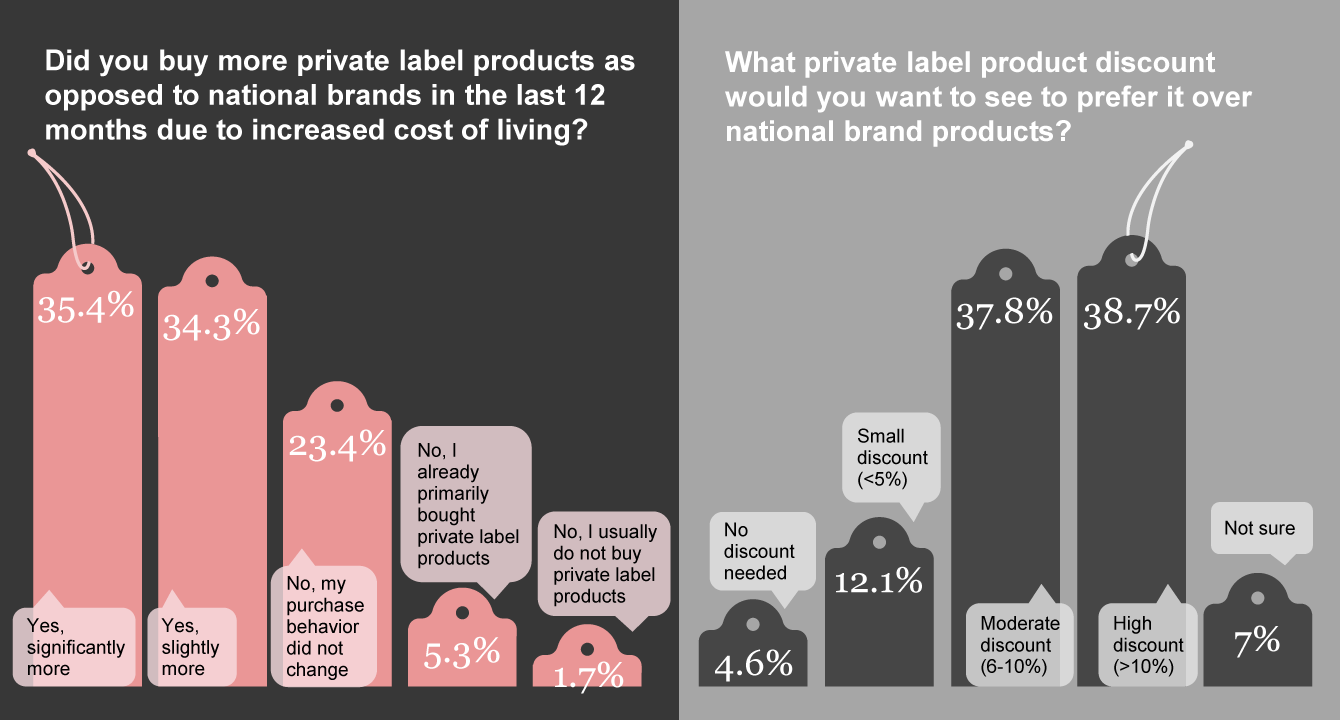
Consumer behavior and discount preferences for private label products
Private label as a whole has shifted from defense to differentiator and can have profit margins of up to 35%, significantly more than national brands.3 As a result, it is expected to grow 6.6% CAGR (2023–2028),4 double the expected overall grocery retail growth,5 and has already reached 39% of grocery market value in Europe,6 driven by shrinking brand loyalty and margin pressure. But this growth has ceilings.
Three dynamics set the limit:
- Consumer brand loyalty differs across categories: Consumer interest in private label is highest in snacks, dairy, frozen and drugstore products,7 while categories like baby and pet food, beverages, and cosmetics typically have entrenched brand loyalties that limit private label growth.
- Intra-portfolio cannibalization: Adding tiers often substitutes existing lines,8 especially in categories like dairy, bakery and frozen where private label shares are already high and growth is flattening. Above a share of typically around 40–50% within a category, potential benefits are frequently outweighed by cannibalization and eroded margins.
- Negotiation leverage: National brands still represent 61% of grocery market revenue,9 and over-reliance on private-label products weakens negotiation power in essential, traffic-driving categories, thus reducing margins.
The implication: precision, not proliferation. Set your private label ambition by setting margin and private label affinity into proportion:
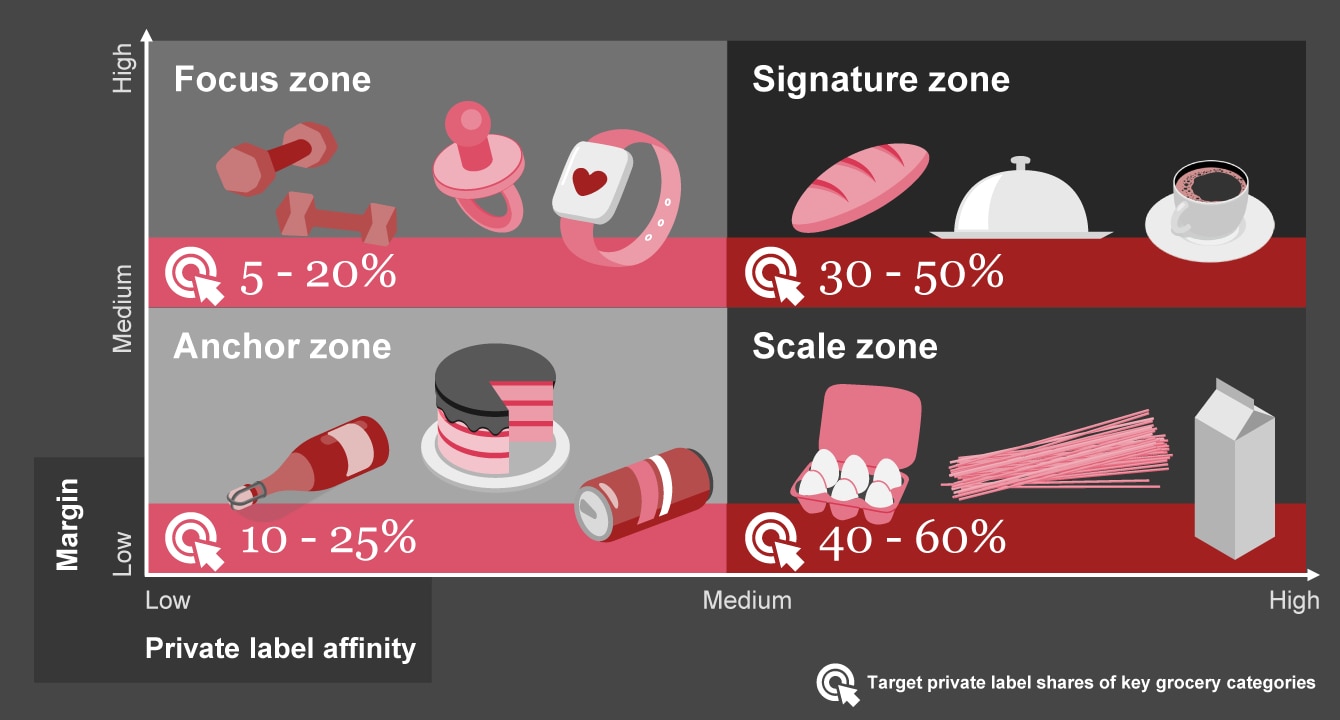
Four zones with target private label shares emerge:
- Anchor (low affinity, low margin): brand-led; use private label to anchor entry price points and as a negotiation lever.
- Focus (low affinity, high margin): focus on premium or specialized categories where winning market share is only possible with sharp differentiation (e.g., unique flavors, sustainability, local sourcing) and focused SKUs.
- Scale (high affinity, low margin): dominate on volume and price perception where scale drives revenue.
- Signature (high affinity, high margin): win share by investing in quality, design, and clear good–better–best tiers.
Next, translate this into action. Set category-level objectives for private label (traffic, margin, trade-up, differentiation) and ceiling shares by zone, not blanket penetration. Where private label nears the percentage target share, simplify: Cut overlapping tiers and back the lines that truly differentiate or drive volume.
Finally, align private label strategy to your business model: Discounters should optimize private label to meet or even selectively exceed suggested barriers, and carry a tight set of national brands in high-loyalty, high-traffic categories. Full-range supermarkets should double down on growth zones, maintain a prominent range of brand choice where loyalty is high, and use private label to cover value and enable credible trade-up. Lastly, measure what matters (repeat purchase rates, cross-basket effects, SKU contribution) and use test-and-learn to set the right ceilings and avoid cannibalization.
There is still runway: 60% of consumers would buy more private label if more variety were available.10 The opportunity is real but targeting matters. With private label, more isn’t always better – smarter is.
1 Strategy& Appinio Survey, conducted in December 2025 (n=2000; Austria and Germany)
2 NiQ Mid-Year Consumer Outlook (2025)
3 Mercator study (2019) – leveraged as structural input
4 Technavio via PR Newswire, Global Private Label Food and Beverages Market, Compound Annual Growth Rate (CAGR) 2023-2028
5 IGD European Channel Forecasts 2025-2030 (2025)
6 Private Label Manufacturers Association International Council (2024)
7 NiQ Mid-Year Consumer Outlook (2025)
8 GEYSKENS, I., GIELENS, K., & GIJSBRECHTS, E. (2010). Proliferating Private-Label Portfolios: How Introducing Economy and Premium Private Labels Influences Brand Choice. Journal of Marketing Research, 47(5), 791–807. http://www.jstor.org/stable/20751544
9 Private Label Manufacturers Association International Council (2024)
10 NIQ - Finding Harmony on the Shelf (Report 2025)
...uses promotions strategically
CEO takeaway: If promotions are not measured for incrementality, they are value-destructive.
Consumers love promotions, and with food prices being the top concern for consumers11 they are more effective than ever. In Germany, grocery prices rose 26% over the last 10 years12 while purchasing power rose only ~5–8%,13 sharpening sensitivity to relevant deals. For products like coffee and tea, over 50% of consumers will even postpone their purchase until a deal is available. Beyond those categories, every fourth consumer chooses where to buy groceries based solely on discount availability, indicating discounts to be the primary loyalty lever. In fact, retailers that pinpoint what to promote, to whom and when can increase customer loyalty by over 76%.
Promotions increase revenue but, unmanaged, dilute margin, especially when unfunded. Hence, retailers must shift from blanket discounting to precision that grows loyalty, purchase frequency and basket value while protecting profit. AI/ML and richer first-party data now enable SKU targeting, pricing, and measurement. The new playbook focuses on value over volume:
- Target with intent: nfer category interest from transactions and trigger offers to those most likely to respond.
- Calibrate depth with elasticity: Estimate SKU/segment elasticity to set discounts just deep enough.
- Design for incrementality: Prioritize added units, trade-up and larger baskets by tying offers to adjacencies.
- Govern with guardrails: Have margin floors, capped frequency, and protected price points to avoid training customers to wait.
- Measure the full P&L: Measure incremental sales and margin impact, halo/cannibalization effects, stockouts and post-promo dips, and feed results back into models.
In practice, run fewer, deeper, smarter events; Retire low-ROI, always-on deals. Deliver segment-specific offers to loyalists, lapsers, and switchers across app, email, and in-store, guided by observed response. This level of precision is unattainable without AI-driven elasticity modeling, real-time targeting, and automated post-event learning loops. The 2026 mandate is clear: Promotions are profit optimization tools. Retailers that institutionalize this approach will stabilize margin while increasing loyalty, category by category.
11 NIQ Mid-Year Consumer Outlook (2025)
12 Trading Economics (2025)
13 Statistisches Bundesamt (2025)
...retail media as profit powerhouse
CEO takeaway: Retail media is not an add-on. It is the highest-margin line of business most grocers will ever build.
Retail media is moving into grocery at pace. Few channels reach shoppers closer to the point of decision, and few levers create as much value for retailers, with retail media often delivering 50–80% profit margins versus ~3% in grocery. The proposition is win–win–win: Advertisers gain relevance and closed-loop measurement, grocers unlock a high-margin, scalable profit stream, and customers get personalized rather than generic ads.
Capturing that value requires intent. The retail media unit should be purpose-built on solid foundations: a clear operating model and commercial mandate, supported by the right IT and data infrastructure.
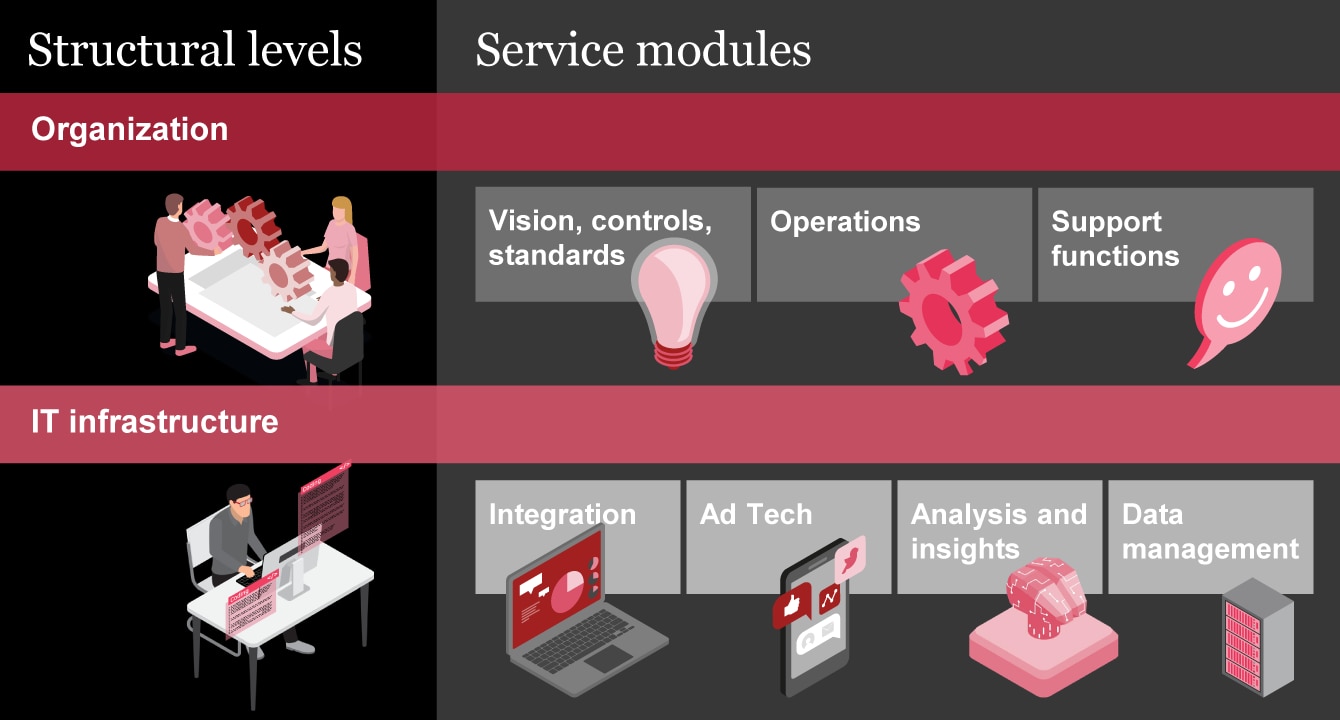
Service framework: structural levels and modules
The starting point is a structured readiness assessment and an explicit build-versus-buy stance. Five factors shape readiness and the roadmap:
- Common definition: Align across functions on what retail media covers (onsite, offsite, in-store, online) for apples-to-apples assessment.
- Current state: Audit channels/formats in market, tech stack, data, measurement and organization.
- Strategic ambition: Define the role in the business and P&L, including pricing, sales coverage and governance.
- Gap analysis: Quantify effort to move from current to target across people, process and technology.
- Build vs. buy: Assess which elements are to be developed in-house and what is best bought externally.
Build-versus-buy choices hinge on two variables: scale (customer base, store footprint, partner demand, media inventory) and tech maturity (data management, ad tech, identity, personalization). Retail media networks have matured and can provide turnkey capabilities without the complexity of investing into in-house models. The hard truth: Retailers without sufficient scale or data maturity will destroy value by attempting to build fully proprietary retail media stacks.
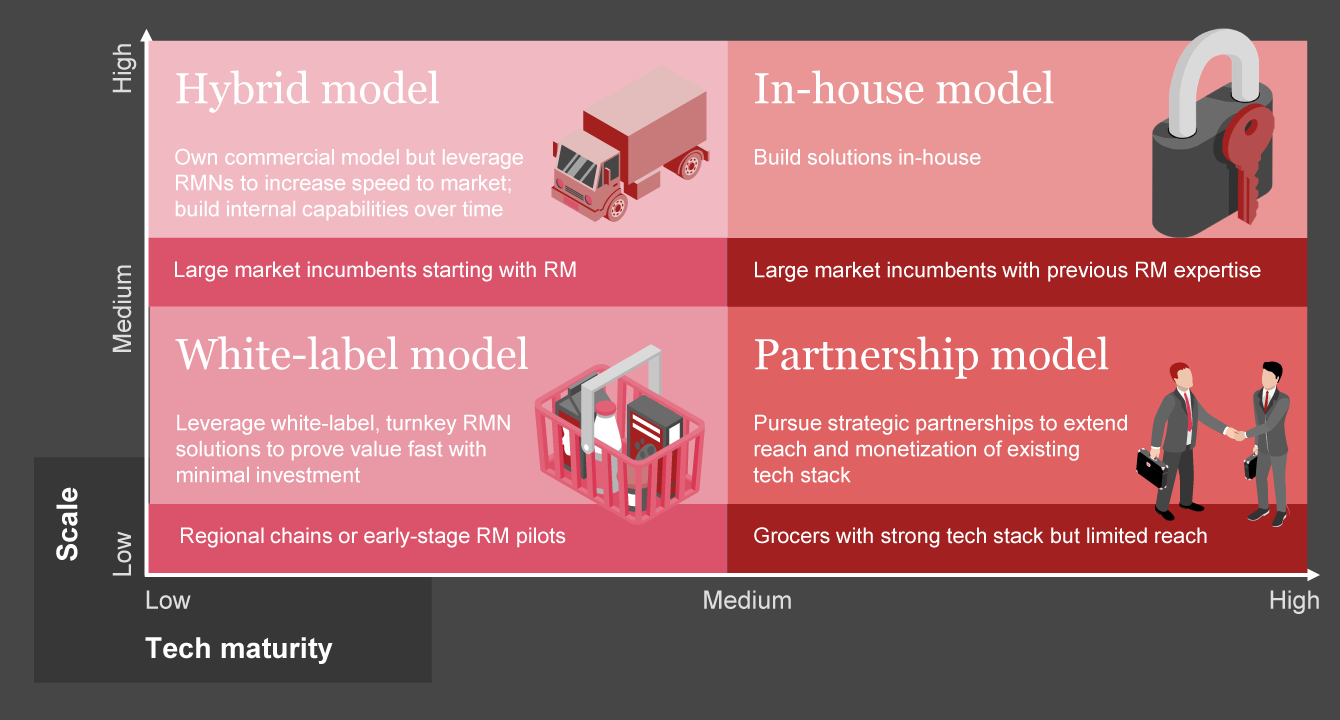
Retail media network business models by scale and tech maturity
To reap the potential, design deliberately. With clear ownership, disciplined governance, robust measurement, and fit-for-purpose allocation of technology and responsibilities, retail media becomes a high-margin growth engine for grocery, serving advertisers with precision while delivering a step change in retailer profitability.
...offers healthy and GLP-1 options
CEO takeaway: Health is becoming as decisive as price - and more profitable.
GLP‑1 medications (e.g., semaglutide, tirzepatide) are no longer a niche diabetes treatment, they have become a cultural marker for weight management and health optimization. Although current overall usage in Europe remains relatively limited and user base estimations differ, there is agreement that this consumer segment is growing at speed. Barmer, one of Germany’s largest statutory health insurances (GKV) estimates the number of patients using such medication to rise from roughly 880,000 in 2024 to about 1.6 million in 2027.14 Others even estimate the user base to be much larger already: The PwC-Voice of the Consumer 2025 study estimates that 5% of respondents are currently using weight‑loss medications and an additional 3% have used them in the past – which translates into an estimated 4 million current weight-loss supplements users in Germany. At the same time, the two leading weight‑loss pharmaceuticals, Ozempic and Mounjaro, already rank among the world’s highest‑revenue drugs, generating a combined annual turnover of around 40 billion USD with continued momentum. Projections indicate that the potential user base could expand significantly by 2030, provided that insurance reimbursement broadens, and production capacity scales accordingly.15 Despite fluctuating nuances in projections this rapid adoption is part of a broader societal mindset change toward healthier living and more proactive personal well‑being.
German consumption data confirms a structural shift: Categories tied to indulgence are losing share, while functional and “better‑for‑you” options are gaining ground. The biggest “losers” of the last decade are meat, with a decline of 3.8 percentage points, alcoholic beverages with 1.2 pp, and tobacco with 1 pp.16 At the same time, health considerations have become decisive in purchase decisions: Attributes such as low sugar (39.7%), high protein content (20.2%), and transparent nutritional labeling (21%) rank among the most important criteria. While value for money and price remain key, as mentioned in the previous chapters, willingness to pay for weight-loss-oriented products is noticeable: Two-thirds of consumers in our survey would be willing to pay a price premium. 31.5% would accept a small increase (up to 5%), 18.5% a moderate one (6–10%); and 6.4% would even pay more than 10% extra.17
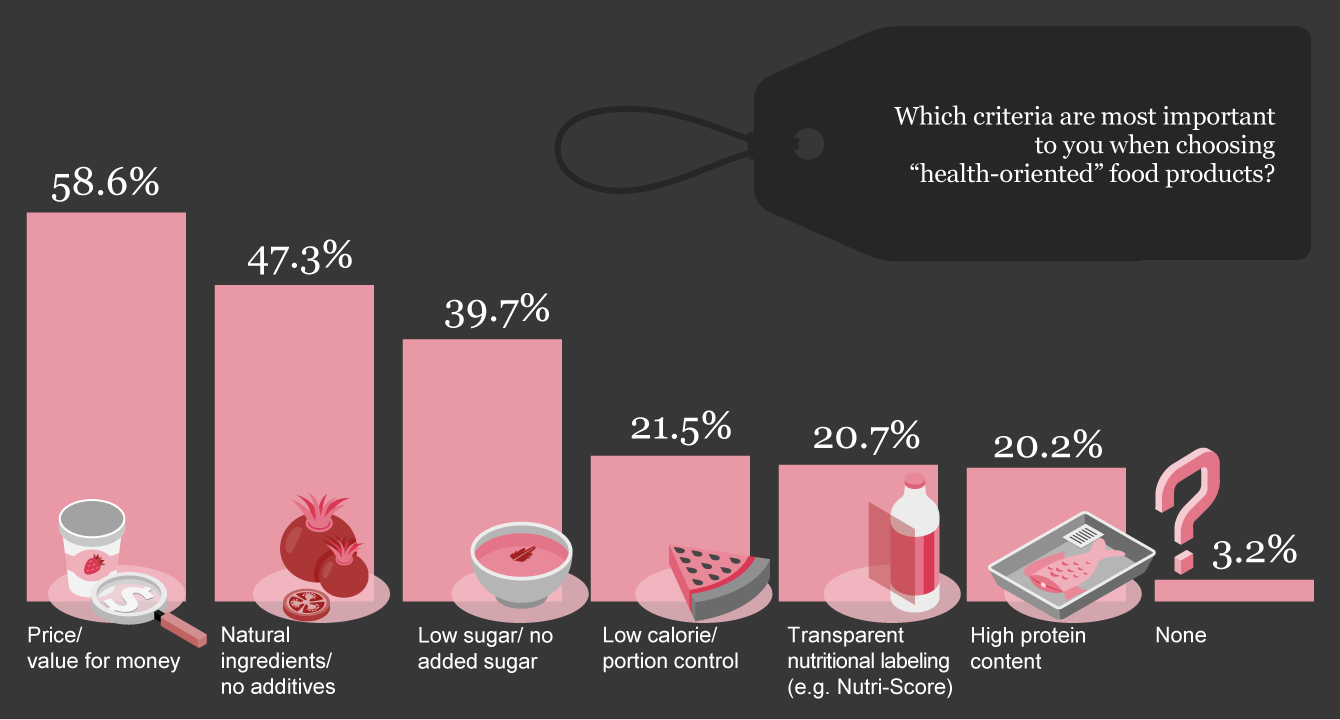
Key criteria influencing consumer choices for health-oriented food products
The effects for grocers go beyond assortment tweaks. Retailers must treat health optimization as a strategic lens for category planning, pricing, and marketing. Three imperatives stand out:
- Segment and personalize: Use loyalty and transaction data to identify health‑focused personas - GLP‑1 users, flexitarians, fitness enthusiasts, and older shoppers seeking functional nutrition. Map preferences (protein, sugar reduction, supplements, fresh share) and tailor offers accordingly.
- Redesign the basket experience: Integrate health cues into existing zones rather than overhauling layouts. Examples could be visual cues to health-focused choices (e.g., high protein, low sugar, etc.) or even specific recommendations for basket composition (e.g., complementary items like a gut-health supplement suggested based on protein snacks). Finally, labeling must be clear and transparent to build consumer trust.
- Co-develop and differentiate: Partner with your suppliers to create GLP‑1‑friendly and functional product lines. Think portion‑controlled ready meals, high‑protein dairy, and sugar‑free indulgence. Private label again plays a key role here, offering margin upside and brand control.
Retailers willing to go further can even explore in‑store wellness hubs, loyalty program tie‑ins, and potentially pharmaceutical partnerships for education and cross‑selling. These moves position the grocer as a holistic health ally for consumers, not just a food provider.
GLP‑1 adoption may remain a minority phenomenon, but its cultural impact and the broader health shift is undeniable. Retailers that anticipate these changes will capture high‑value segments and protect margin in a market where “health” is becoming as decisive as price.
14 Bifg – Barmer; Gesundheitswesen aktuell (2025)
15 Die 10 umsatzstärksten Arzneimittel – Medscape (2024)
16 Global Data 2025 - German Food Retail - Comparison of 2015 volumes vs. 2029 projected volumes
17 Strategy& Appinio Survey, conducted in December 2025 (n=2000; Austria and Germany)
...drives margin resilience
CEO takeaway: Centralization is not about control - it’s about decision speed and economic leverage.
Centralization has become a key lever for driving margin resilience and operational efficiency in today’s retail landscape. Companies that centralize purchasing or pricing, for example, can consolidate orders, negotiate higher volume discounts, and minimize duplication - resulting in superior forecasting and tighter budget control. Evidence shows that firms with centralized purchasing spend an overhead of $4.92 per $1,000 of revenue, compared to $6.10 under decentralized models, highlighting a clear structural advantage.18
Evidence from the State of Grocery Retail Europe report shows that scale and centralization go hand in hand in driving superior performance. Growth champions (retailers 35 to 50% bigger than the average peer) achieve EBITDA margins 0.8 percentage points higher than the industry average. Beyond profitability, these players deliver twice the sales growth and five times the sales productivity growth compared to other grocers.19
These are just two illustrative examples, but the principle of centralization applies far beyond procurement and pricing. The real question is: Which activities can and should be centralized, and where does decentralization remain critical? Identifying this balance is key to unlocking efficiency without losing local responsiveness. To address this question, we introduce three categories of centralization - each defined by clear criteria, advantages, and disadvantages - to help determine what should be centralized first, what comes next, and what is better left decentralized.
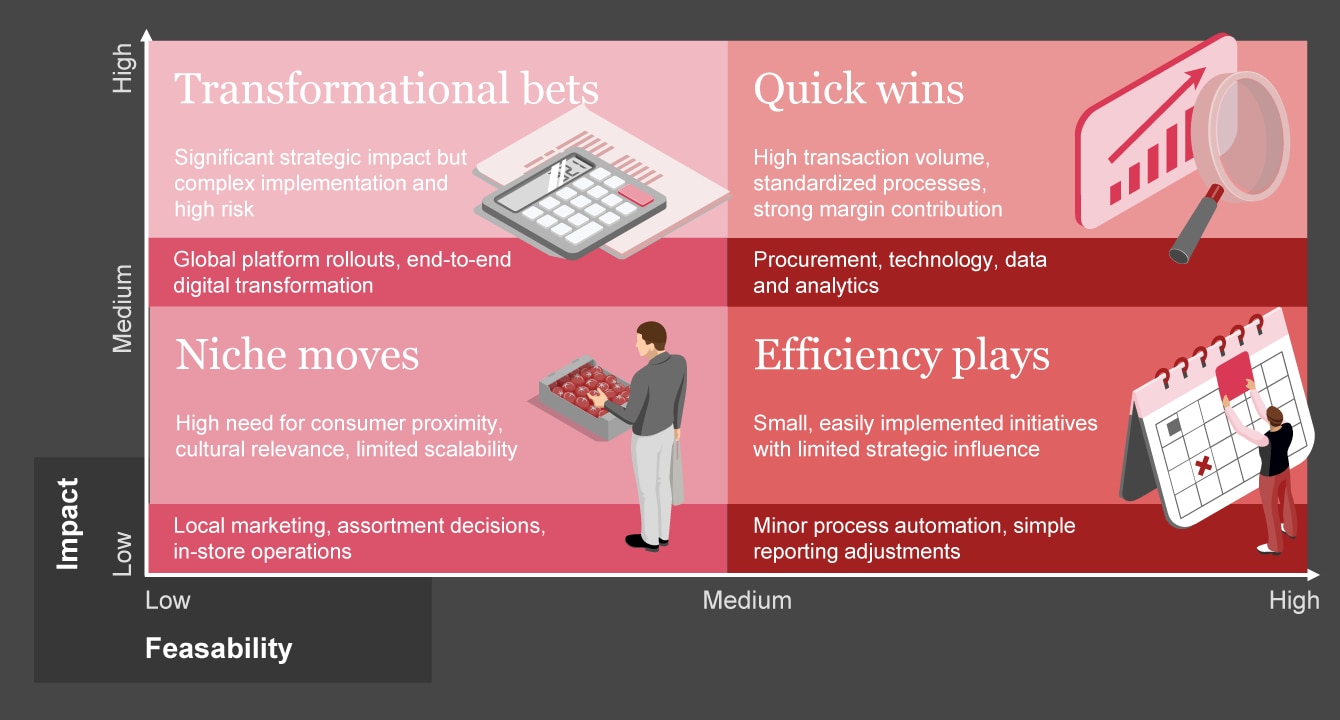
Matrix for prioritizing initiatives by impact and feasibility
Looking ahead, grocery retailers should begin by establishing procurement and analytics hubs to secure quick wins and build momentum. Adopting a hub-and-spoke model - centralizing core capabilities while maintaining local flexibility for assortment and shopper engagement - strikes the optimal balance between efficiency and responsiveness. Finally, invest in governance and change management, as any centralization initiative will fail without clear accountability and cultural alignment.
18 Supply & Demand Chain Executive Study (2025)
19 State of Grocery Retail Europe Study (2025)
...regulatory and supply chain mastery
CEO takeaway: Compliance without resilience is margin erosion - resilience without foresight is cost inflation.
The coming years present retailers with a dual challenge:
- Stricter EU regulations are reshaping cost structures and operating models
- Geopolitical risks and supply chain volatility threaten security of supply and margins
These two dimensions are deeply interconnected: Regulatory requirements such as packaging and food waste directives directly impact supply chains, and only resilient supply chains can enable their efficient and cost-effective implementation.
To navigate this complexity, it is critical to understand what is changing and when, and to act decisively on both fronts rather than treating them as separate priorities.
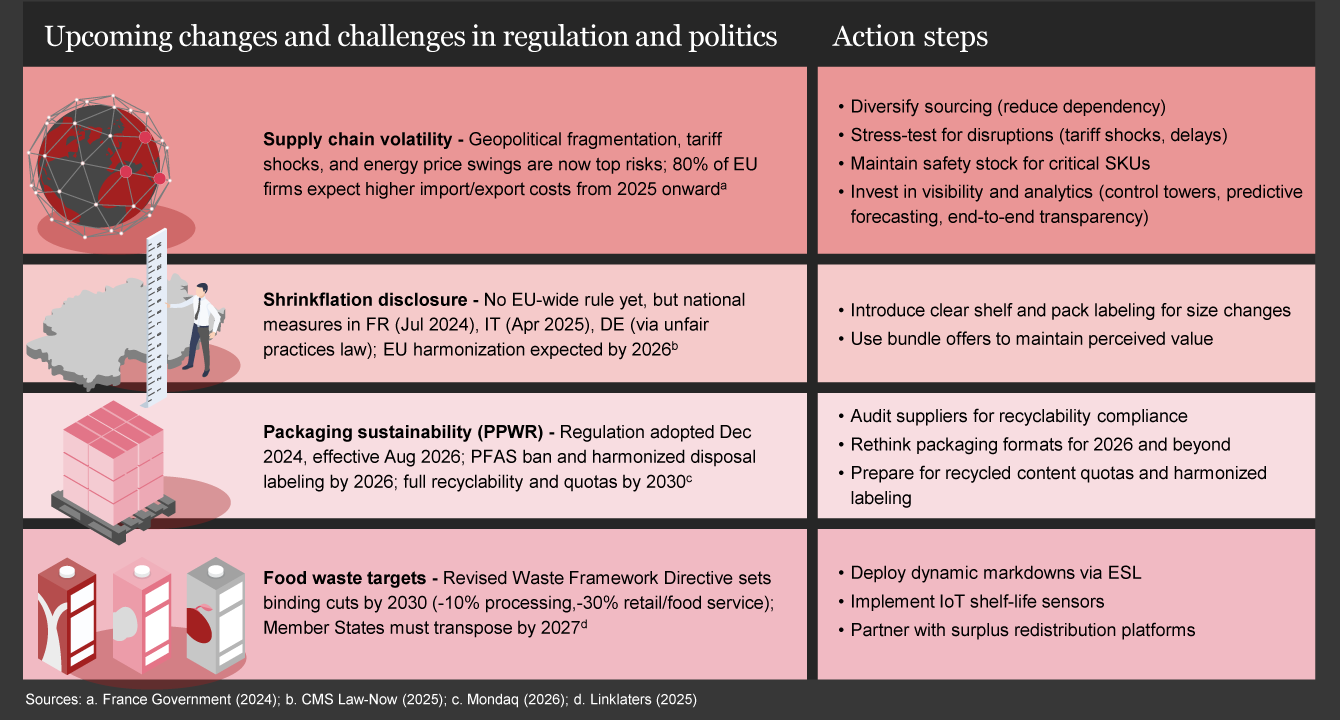
Upcoming changes and challenges in regulation and politics
By embedding these action fields into the operating model, retailers move from reactive compliance to proactive margin protection. Those who master both regulatory complexity and supply chain resilience will not only mitigate risk, but turn it into a source of competitive advantage.
...AI across the value chain
CEO takeaway: In 2026, AI is no longer a technology decision - it is an operating model decision.
The conversation around AI in grocery retail has matured. What began as a back-office tool for forecasting and automation is now permeating every layer of the business, from strategic planning to store execution. In 2026, the winners are those who move beyond isolated pilots and embed AI into the operating model, enabling smarter decisions, faster reactions, and more empowered teams.
One of the most visible shifts is the rise of AI as a real-time operational partner. In-store, voice-first interfaces and intelligent task orchestration are replacing static dashboards and manual checklists. Carrefour, for example, is piloting a connected store platform in its Villabé hypermarket in France, equipped with 70,000 electronic shelf labels, 500 AI-enabled cameras, and 7,000 smart rails. The system uses computer vision and real-time data to monitor shelf stock and compliance, while also flagging urgent tasks such as restocking or pricing corrections for store associates. Carrefour describes this as a move to “turn the store into a digital asset central to our model,” combining operational excellence with economic efficiency.20
Tesco, meanwhile, has focused on AI to streamline store operations and reduce repetitive workload. In early 2025, the company reported a 40% reduction in manual labor hours related to price updates following the rollout of its AI-powered PriceFlex platform. This system automates shelf pricing adjustments based on real-time signals such as competitor pricing, weather, and customer traffic, freeing up store staff to focus on higher-value tasks.21
The common thread across these innovations is not just the technology, it’s the shift in mindset. AI is no longer a siloed initiative; it is becoming the connective tissue of modern grocery operations. To capture its full value, retailers must:
- Build cross-functional AI fluency: Ensure that teams across operations, marketing, and IT understand how to use AI tools and interpret outputs.
- Prioritize real-time enablement: Move from retrospective analytics to live decision support - whether for a category manager adjusting assortment or a store associate restocking shelves.
- Design for adoption: Focus on intuitive interfaces, clear use cases, and measurable impact to drive frontline engagement and sustained usage.
In a market defined by margin pressure and rising complexity, AI is not a silver bullet, but it is a force multiplier. Retailers who operationalize it across the value chain will not only move faster and smarter, but also unlock new levels of agility, precision, and resilience.
20 Retail Systems (2025)
21 Business News Today (2025)
Conclusion
2026 is not just another year on the calendar - it’s an inflection point. Cost pressure, regulation, health-driven demand, and digital monetization are converging into the most decisive moment European grocery has seen in a decade. The retailers who win will not be the ones who do a little bit of everything, but the ones who commit: commit to precision in private label, intelligence in promotions, professionalism in retail media, and discipline in centralization and resilience.
The window is open but narrowing fast. Those who move first will define the next era of value creation in European grocery. Everyone else will spend the following years trying to catch up structurally, not tactically.