Truck Study 2026
The global race for truck electrification
Dr. Jörn Neuhausen and Dr. Philipp Rose
Executive summary
- BETs reached about 8% of global truck production in 2025, driven almost entirely by China, which accounts for 95% of volume. Europe is ramping up slowly, and the U.S. has stalled
- The future truck powertrain is electric. ICE efficiency gains are now incremental and hybridization only bridges select use cases, so competition shifts to battery system, eDrive, and powertrain integration
- BETs deliver a clear total cost of ownership advantage, about 25% in Europe by 2030, but adoption depends on charging infrastructure, depot grid access, and fleet confidence
- China's BET ramp-up is running 150% ahead of forecast while Europe and the U.S. fall behind, putting pressure on European OEMs to defend their home market against Chinese scale
- Scaling truck electrification takes a coordinated strategy across regulation, OEMs, logistics, energy, charging, and financing. No single player can build the ecosystem alone
1 Introduction
Global truck electrification is entering full ramp-up mode
The global truck electrification race has already begun, and the economics have been decided. Battery electric trucks (BETs) beat diesel on total cost of ownership today, which means the open question is who sets the pace and who captures the value.
Built on proprietary TCO modeling, powertrain archetype analysis, and regional market forecasts, the study focuses on four key heavy- and medium-duty use cases: long-haul, line-haul, distribution, and specials.
The momentum is real, but it is uneven. China is turning BETs into an industrial standard and outpacing its own forecast by 150%. Europe and the U.S. are falling short, held back by lagging charging networks, unstable policy, and cautious fleet operators. That gap is the story of the global electrification race.
2 BET potential
Is truck electrification also an energy-independence strategy?
Yes. Beyond cost and carbon, going electric reduces a country's exposure to imported oil, while the payoff varies by region:
- Trucks account for roughly 11-17% of total oil demand across the U.S., EU, and China
- Full BET penetration could cut imported-oil exposure by about €50 billion a year in China and €20 billion in the EU
- The U.S. gains the least, because its role as a net oil exporter limits the strategic upside
- For China and Europe, electrification is as much about energy security as it is about economics
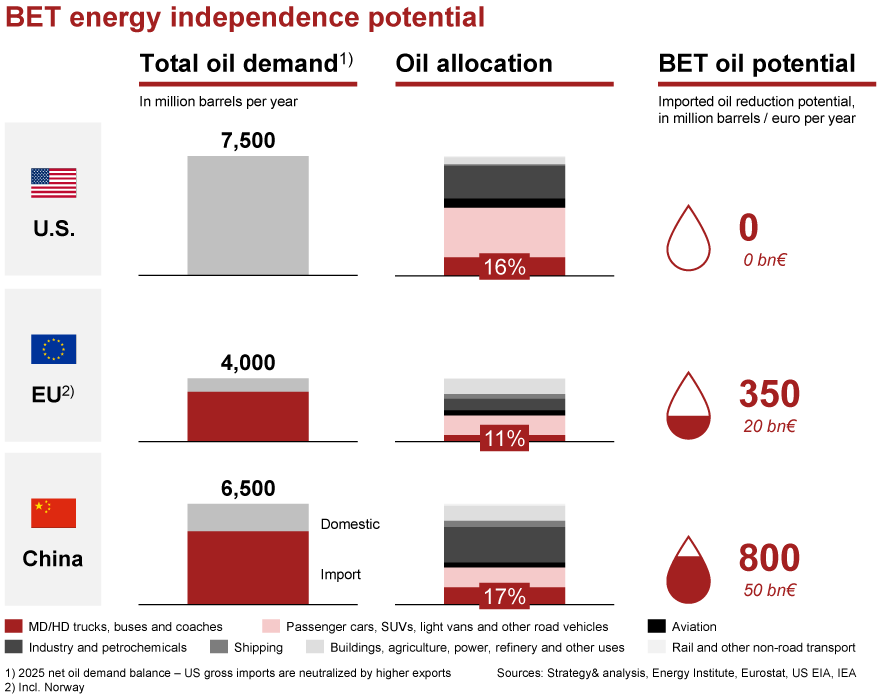
BET energy independence potential
3 Infrastructure gap
What decides the truck electrification ramp-up now?
Cost is no longer the barrier. Chinese OEMs already account for more than 96% of the world's top-20 BET output. But that playbook, built on aligned economics, policy, and use cases, does not automatically transfer to the West, where the binding constraint is different. BETs already win on total cost of ownership across regions and use cases, so cost is no longer the issue. Two other factors now decide the pace:
- Infrastructure: Public charging availability, depot grid access, and local transformer capacity determine how fast fleets can electrify
- Confidence: Stable regulation, clear policy support, and positive public perception build the confidence needed for a costly logistics transformation
Where each region stands today:
- China leads with roughly 6,000 public HDV charging locations plus battery swapping
- Europe has broad coverage but lower charging depth and power
- The U.S. is still early-stage, with about 1,000 open locations
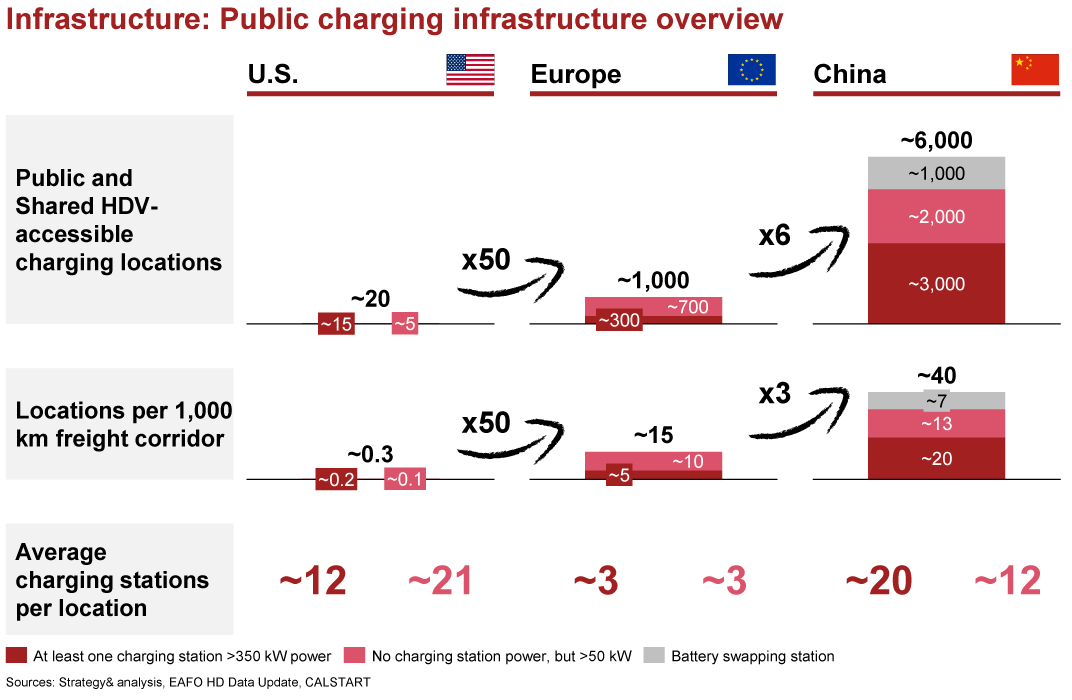
Infrastructure: Public charging infrastructure overview
4 Market share
Market share in home markets: China vs. Europe
Comparing the 2024 forecast with 2026 actuals reveals a widening divide: China is +150% ahead of forecast, while Europe is −80% and the U.S. −95% behind.
And the threat is now on home turf. European OEMs' domestic BET share is projected to fall more than five percentage points in three years as key Chinese and U.S. OEMs establish production in Hungary, Turkey, and other locations to enter Europe’s BET market, putting domestic market share at risk, while China's market stays ~98-100% domestically supplied. The optimism baked into Western forecasts never materialized, while China broke through the ceiling and began exporting its playbook.
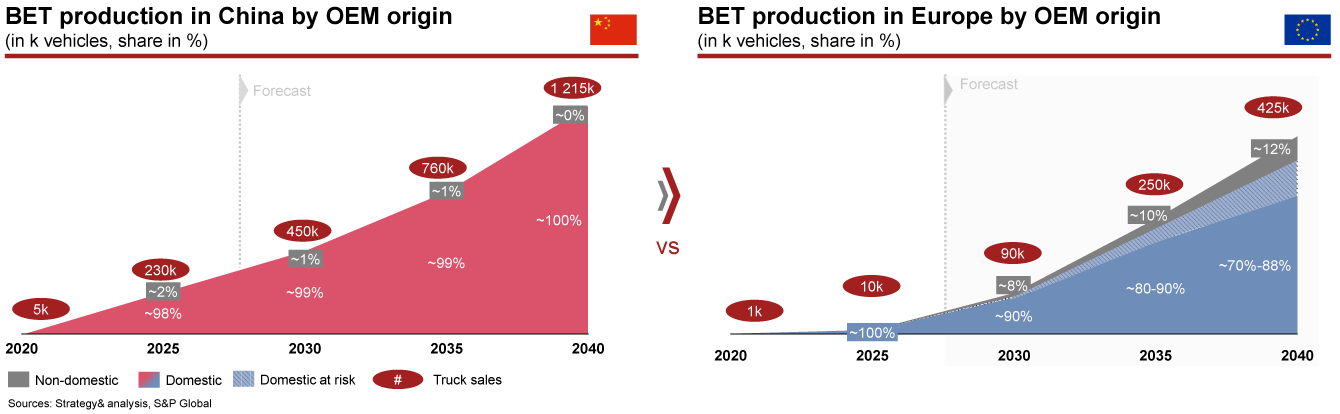
Market share in home markets: China vs. Europe
5 Recommendations
Cross-industry efforts to energy, charging, construction, and logistics execution
The economics are settled, so execution decides who wins. Three moves separate the leaders from the left-behind.
- OEMs: compete beyond the vehicle
Differentiate through use-case-tailored BETs, uptime guarantees, service density, and integrated charging and software ecosystems. - Logistics operators: get BET-ready now
Map suitable routes, align schedules with charging windows, and build depot charging ahead of scale. - Enablers: build the backbone in parallel
Energy, charging, construction, and the public sector must deliver grid access, depot readiness, and public HDV charging, backed by policy certainty and faster approvals.