Global cyber benchmarking study
The road to holistic and hybrid cyber resilience
Lucas Sy
Executive summary
- Based on a survey with international cyber experts, the global cyber benchmarking study analyzes governments’ responses to cyberattacks and their holistic and hybrid approach to cyber resilience in eleven countries on four continents
- Cyber security is increasingly embedded in national policy to drive economic growth and technological leadership, creating a strong foundation for broader cyber resilience
- Public-private collaboration and international alignment are central to turning policy into holistic and hybrid cyber resilience across borders
- Regulatory frameworks and capacity building – especially data privacy and information security laws – are essential to building cyber capacity
- The evolving legal landscape, including cyber security policies, reinforces protection of individual rights and supports coordinated cyber governance in a rapidly changing threat environment
1 Introduction
Understanding global cyber threats and the path to cyber resilience
Cyber threats continue to grow globally and present key risks to organizations and society, both digitally as well as increasingly intertwined with the physical world. Countries worldwide consistently rank cyberattacks among the most severe risks they face, demonstrating the urgent need to strengthen cyber resilience.
Our global cyber benchmarking study evaluates strategies and actions governments are taking in response to these challenges, analyzing their holistic and hybrid approach to cyber resilience. We surveyed cyber experts on four continents to identify and assess cyber security policies in eleven countries: Canada, Germany, France, Hong Kong, Israel, Morocco, the Netherlands, Singapore, South Africa, Tunisia, and Ukraine.
We argue that only a holistic and hybrid approach to cyber resilience will suffice. A nation can only attain cyber resilience by leveraging the entire cyber toolkit across both the public and private sectors and by protecting all infrastructure in the digital, physical, and human spheres. With the Cyber Skyward Curve, we introduce a practical tool designed to improve holistic and hybrid cyber resilience.
2 Trends
Global cyber trends and shifts in cyber resilience
There are three fundamental trends shaping how countries approach cyber resilience:
- The growing integration of cyber security into broader national goals
Countries are increasingly embedding national cyber security strategies into broader national goals such as technological leadership, public safety, and economic prosperity. This interconnected approach enhances hybrid and holistic cyber resilience, ensuring that cyber security is not discussed and applied within a silo, but is always taken into account when making decisions on all national policy priorities and strategic goals. - The commitment to public-private collaboration and international alignment
Across three dimensions – national standards, organizational capabilities, and legislation – the analyzed countries demonstrate a strong commitment to fostering public-private collaboration on holistic and hybrid cyber resilience. Moreover, countries increasingly seek international alignment on cyber security standards to spread cyber resilience initiatives through shared learning and collective action. - Emphasis on the interaction between regulatory frameworks and capacity building
Countries are increasingly capitalizing on the interaction between regulatory frameworks and capacity building to transmit cyber security measures. Comprehensive laws on information security and data privacy help establish clear governance and compliance mechanisms. Once in place, these mechanisms incentivize investment in developing cyber security skills and capabilities.
3 Dimensions
Building cyber resilience across key dimensions
Our analysis reveals underlying patterns within three dimensions, showing how countries translate cyber security policies into action.
4 Cyber Skyward Curve
Cyber Skyward Curve: A framework for advancing cyber resilience
Our Cyber Skyward Curve traces what each stage of holistic and hybrid cyber resilience signifies for a given country and is intended to serve as a framework that can be tailored for each nation.
The curve consists of four phases: Fragmentation and vulnerability, bureaucratic hurdles, policy maturation, as well as cultural integration and enforcement. This framework allows policymakers and their private sector counterparts to assess current progress and anticipate potential obstacles, while enhancing the general debate about cyber security policies that boost holistic and hybrid cyber resilience.
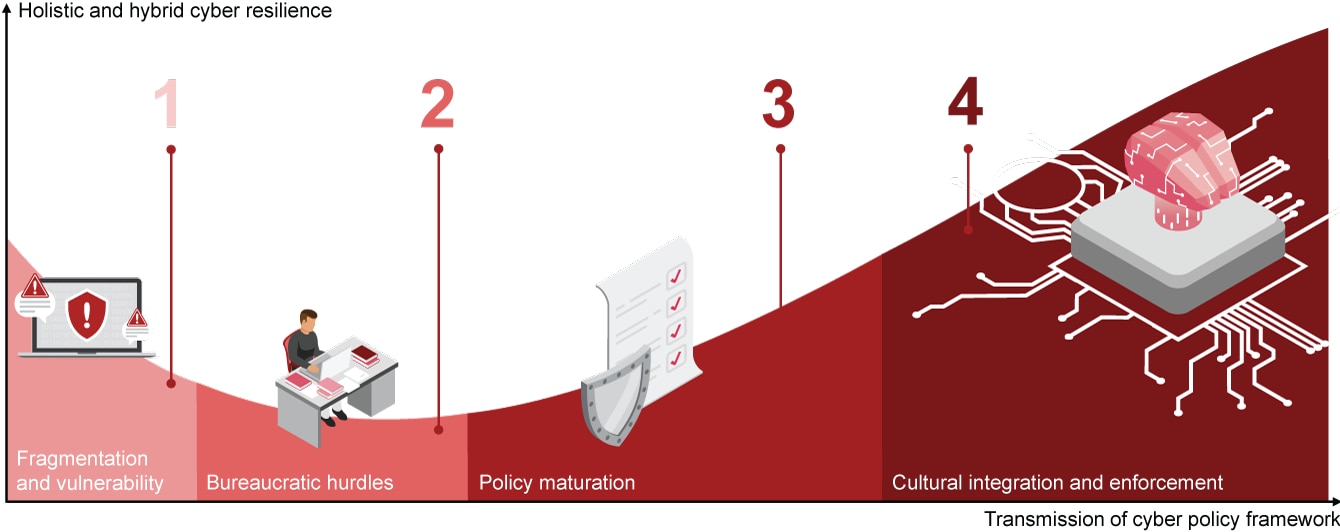
Cyber Skyward Curve
5 Conclusion
Building a lasting culture of cyber resilience
Countries are increasingly integrating cyber security into broader national goals, leveraging public-private collaboration and international alignment to achieve holistic and hybrid cyber resilience. Regulatory frameworks combined with capacity building are delivering robust and long-term resilience.
However, establishing national strategies, organizational structures, and legislation is only the beginning. To address emerging risks and prevent complacency, countries must cultivate a deep awareness and culture of cyber resilience across all levels of society.
Jonas Piduhn co-authored this report. The authors would like to thank Andreas M. Lang, André Glenzer, David Uhrig, Tobias Vosecky, Maximilian Friedmann, Carsten Hoffmann and Fabian Wick for their further contributions.
Global cyber benchmarking study
Methodology
Our survey consisted of 40 questions based on three core dimensions: national standards, organizational capabilities, and legislation. National standards examines cyber security strategy and cyber security standards covering organizational and technical methods, IT security products, and certifications. Organizational capabilities assesses the establishment and functions of dedicated cyber security agencies, public-private sector coordination, and capacity development measures including professional training, education programs, research and development, and industry support. The legislation dimension investigates information security laws and data privacy regulation covering data subject rights, organizational and technical measures, risk assessments, and data transfer requirements.