Industry of tomorrow: How we make
Reinvention in the machinery and equipment industry
Bernd Jung, Dr. Birger Steinmeier, Florian Nöll, and Georg Krubasik
Executive summary
- The German machinery and equipment industry is under significant pressure. 54% of companies report stagnating or declining markets, while 33% see new disruptors entering their core business – primarily from non-European players (59%) and adjacent industrial sectors (54%)
- The most significant disruption is coming from the demand side, with customers moving away from asset ownership to outcome-based models focused on availability, productivity, and total lifecycle cost, not just machines
- German manufacturers' traditional strengths – engineering excellence, quality, and reliability – are still necessary but no longer differentiating. Products with comparable quality can now be sourced from elsewhere in the world at lower cost and companies are finding it increasingly difficult to defend margins through hardware improvements alone
- A fundamental gap has opened between today's revenue reality and tomorrow's value creation. Over 66% of revenue still comes from products and services tied to physical sales, yet future value creation lies in operations, system enablement, and digitally connected ecosystems
- Reinvention requires building on the core business in new ways, combining hardware with software, services, and new commercial models – driven by an organization that works across silos toward more agile and customer-oriented set-ups
- German manufacturers are well positioned for this reinvention if they rely on their strengths: data access through a large installed base, customer trust through long-standing relationships, and deep ecosystem know-how
1 Introduction
How Germany's machinery industry must transform to compete
The German machinery and equipment industry has long been synonymous with engineering excellence, precision, and global leadership. But that legacy alone is not enough to secure long-term business success.
With 54% of companies reporting stagnating or declining markets, while new competitors are emerging from non-European markets and adjacent sectors, the industry faces a structural inflection point. At the same time, customer demand is shifting from product ownership to outcome-based models focused on availability, productivity, and total lifecycle cost. While companies still generate 66% of their revenue through product sales, future growth increasingly lies in operations, system enablement, and digitally connected ecosystems. Industry reinvention is no longer optional, it is essential.
To understand how far the industry has come and what still needs to happen, Strategy& surveyed nearly 200 senior executives from the German machinery and equipment industry. Combined with in-depth expert insights from the PwC network and industry representatives, this study examines the most critical questions around business model reinvention:
- How urgent is the need for new business models?
- How advanced is the industry in its implementation?
- Which business models hold the most promise?
- And what separates the frontrunners from the rest?
2 Market under pressure
Stagnation, disruption, and the new competitive reality in industrial manufacturing
The two top drivers of reinvention are external: More than three in four executives (79%) cite market and competitive dynamics as the most important factor. Chinese and other Asian players now match or exceed European standards in quality, innovation, and customer service – even in highly engineered products. Traditional barriers to entry that once protected European manufacturers – technical complexity, certification requirements, and deep domain expertise – are eroding as global competitors close the capability gap. Technological shifts, named by 72% of respondents, compound the pressure. Speed to market and the ability to radically rethink offerings are becoming critical to sustaining a strong market position against external disruptors.
At the same time, customer preferences are evolving: Not the machine is creating value, but its output, efficiency and reliable operations. As a result, many customers are shifting from asset ownership to capital-light operations and outcome-based contracts. This creates a fundamental tension in an industry where most revenue today still comes from physical product sales.
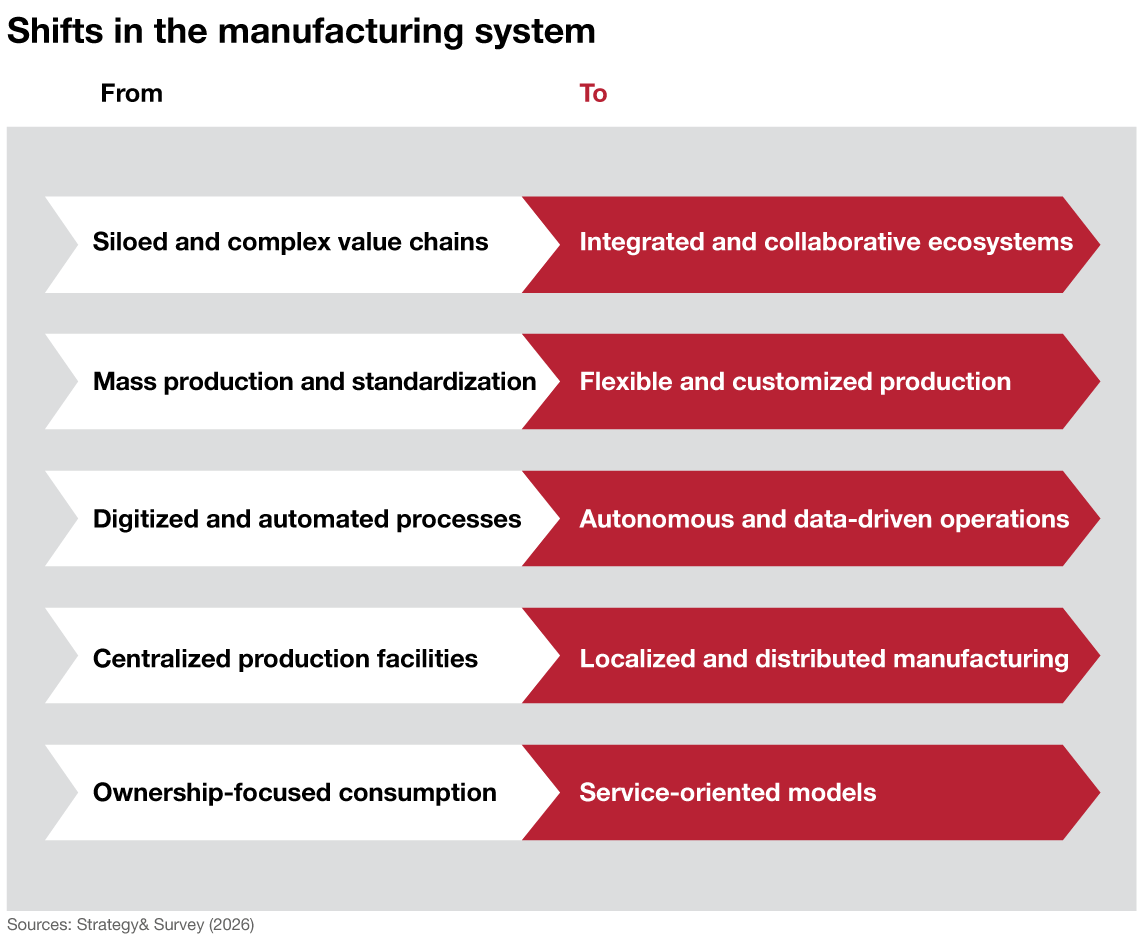
Shifts in the manufacturing system
3 From products to outcomes
From machines to outcomes: A new revenue reality for industrial manufacturing
Despite mounting pressure, most manufacturers remain anchored in their traditional model. More than two thirds of revenue still comes from physical product sales. Operating models and capabilities are largely optimized for product delivery – not for managing the customer lifetime value across the full lifecycle of the asset.
Services and spare parts generate significantly higher margins, yet account for only around 13% of revenue. More advanced offerings – digital services, performance-based contracts, or integrated solutions – represent not more than 4%. This means that manufacturers are leaving significant value on the table at every stage of the customer journey, from initial sale through decades of operation.
The imperative is clear: To withstand competitive pressure and meet the demands of every customer segment, manufacturers must invest far more in service-based and outcome-oriented business models. But this requires more than portfolio rebalancing. It demands organizational capabilities, structures, and incentives that enable service scaling, customer centricity, and rapid execution.
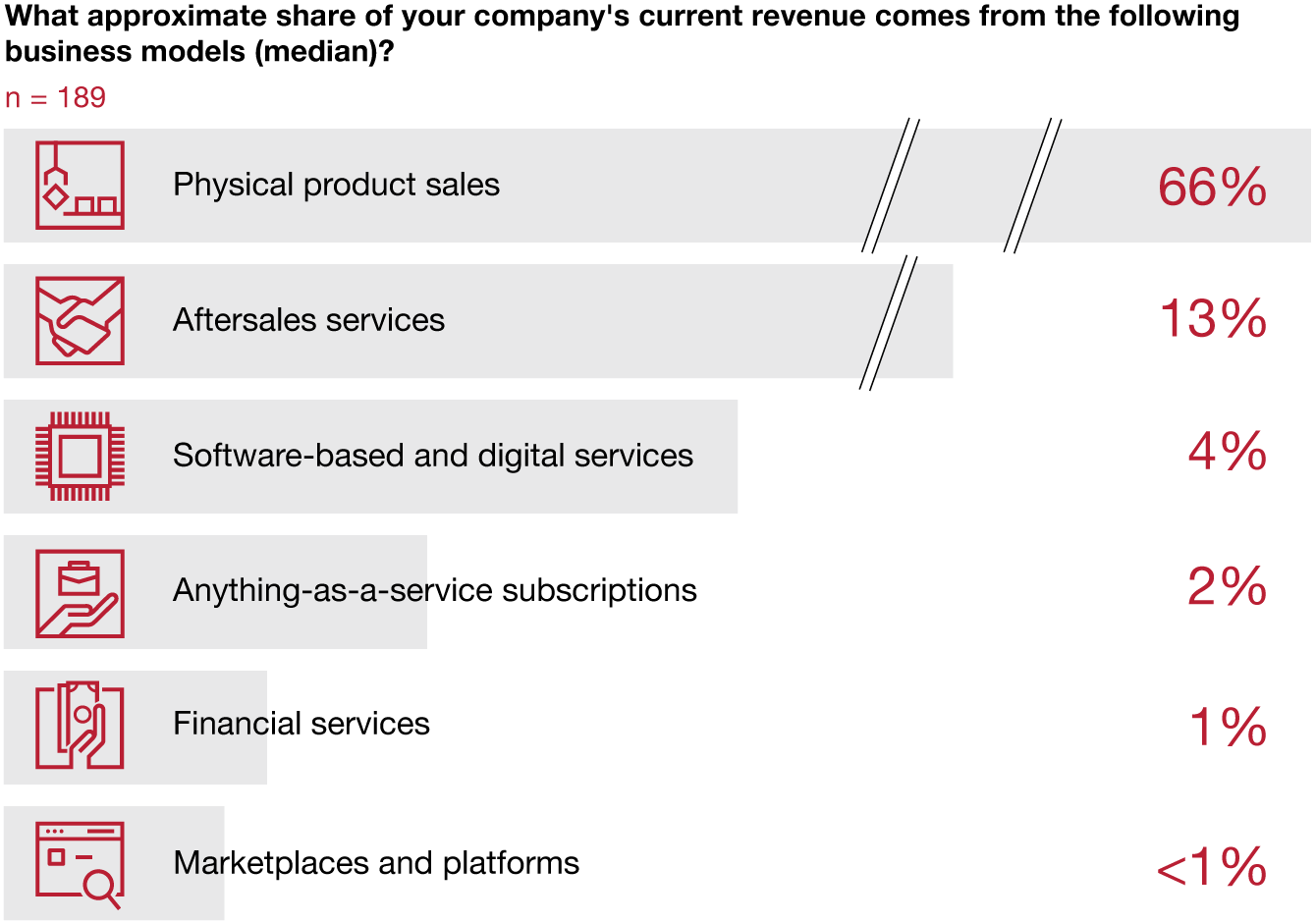
Current revenue shares by selected business models
4 The reinvention imperative
Three layers of reinvention in industrial manufacturing
Incremental adjustments are no longer sufficient. What is required is a structured rethinking of the manufacturer's role – and its value proposition to the customer.
Reinvention should not be confused with product, process, or management innovation. While those improve the existing business, reinvention is strategic and outward-facing. It responds to fundamentally evolving customer needs – through service-oriented or outcome-based models that go beyond machinery ownership. By redefining how value is created and captured, reinvention enables manufacturers to reach potential customers in new markets and compete in entirely new industries.
How reinvention takes shape depends on a company's starting point, strategic ambition, and the capabilities it can build or access. It unfolds across three layers:
1. Asset-focused reinvention
Providing access to capacity
Ensuring customers get the equipment they need in the most cost-effective and flexible way – through ownership, leasing, rental, or pay-per-use models. These models lower commitment thresholds and increase customer flexibility, making it easier to attract potential customers who would not commit to traditional capital purchases.
2. Operations-focused reinvention
Transforming capacity into output
Helping customers convert installed machinery into output more efficiently – through remote asset performance solutions, energy optimization, and workforce enablement that improve productivity, uptime, quality, and safety. By using customer data and real-time operational insights, manufacturers can move from reactive service to proactive performance management – deepening customer loyalty and increasing switching costs.
3. System-focused reinvention
Making the system work end to end
Enabling the entire system to work seamlessly by connecting operations, supply chains, data, and partners – through digital platforms, analytics, and sustainability solutions. At this level, manufacturers orchestrate value across the full customer journey, turning customer feedback and operational data into continuous improvement loops that build trust and long-term partnerships.
5 Key strengths
Leveraging key strengths for industrial manufacturing reinvention
As value creation shifts from selling assets to delivering asset performance, the basis of competitive advantage is evolving. Engineering excellence, product quality, and reliability remain essential – but they are no longer sufficient. Tomorrow's winners will combine strong hardware with customer trust, service capability, digital enablement, and measurable impact on customer outcomes.
German manufacturers are well positioned – if they fully capitalize on three distinctive strengths:
Translating these strengths into new growth requires more than ambition. It demands organizations that can move faster, work across silos, and combine technical, commercial, digital, and service capabilities around evolving customer needs.
6 Conclusion
Why industrial reinvention cannot wait
The German machinery and equipment industry stands at a defining moment. The pressures are real, but so are the opportunities.
Companies that act now – investing in new business models, building digital capabilities, and reorienting from pure product sales to outcome-based and ecosystem-driven value creation – will secure lasting competitive advantage and define the next era of industrial leadership. Those that wait risk being overtaken by more agile competitors, both from within Europe and beyond.
This study provides a clear roadmap: Understand the urgency, learn from the frontrunners, and take decisive action.
Three questions require immediate executive attention:
- Where does your current business model create value, and where is it losing relevance?
- What new capabilities and revenue streams must you build or acquire?
- Are your organizational structures and incentive systems enabling or blocking reinvention?
Dr. Thomas Wolf, Anna Went and Dr. Michelle Beck have co-authored this report.