Crypto Survey 2026
Digital assets after another market correction – what’s next?
Dr. Philipp Wackerbeck, Felix Becht, Dr. Antoine Khadige, and Jeroen Crijns
Executive summary
- Investor conviction holds firm through market correction. 56% of retail investors used the early 2026 volatility to buy the dip, and more than 80% still plan to increase their digital asset allocation in the next 12 months
- Tokenized assets hit a tipping point. Over 75% of retail investors now say they are likely to invest in tokenized assets if accessible through their bank or trading platform, up sharply from 38% in 2025
- Stablecoins are becoming payment infrastructure. 31% of investors have already used stablecoins for cross-border transfers, signaling a direct challenge to conventional payment channels
- Long-term strategies dominate. Buy and hold (54%) and savings plans (50%) are the most popular investment approaches, while day-trading is declining – indicating a maturing investor base
- Trust and integration as the new battleground. Trustworthiness and security are the top criteria when selecting a trading platform, and banks must integrate stablecoin transfers and tokenized assets to remain relevant to this growing investor segment
1 Introduction
Retail investors hold firm as the digital asset market matures
The 2026 Strategy& Crypto Survey is the fourth edition of our ongoing study tracking retail investor sentiment in digital assets. Since our last survey in early 2025, the market has shifted significantly. Bitcoin crossed the $100,000 threshold before correcting sharply in early 2026, putting investor conviction to the test after a prolonged period of euphoria.
At the same time, the broader ecosystem has matured considerably. The European Union's comprehensive legal framework for the crypto industry, Markets in Crypto-Assets Regulation (MiCA), is in full effect across the EU. U.S. Bitcoin spot ETFs marked their first anniversary with over $35 billion in net inflows. Stablecoins reached record settlement volumes. And tokenization moved from concept to reality, with tokenized real-world assets surpassing $10 billion.
Against this backdrop, we surveyed 2,500 retail investors in March and April 2026 across the United States, Germany, Saudi Arabia, the UAE, and the Netherlands.
2 Trends
Buying the dip: Retail conviction remains strong
Despite the sharp correction in early 2026, 56% of retail investors used the recent volatility to buy the dip. More than 80% still plan to increase their digital asset allocation over the coming 12 months. Portfolio allocations remain stable, with the majority of investors holding between 5% and 20% in digital assets while only approximately 9% exceed the 20% threshold.
Bitcoin continues to dominate retail portfolios, held by 68% of investors, followed by Ethereum and Solana.
Tokenized assets: From niche interest to mainstream demand
Sentiment toward tokenized assets – traditional asset classes represented on the blockchain – has increased dramatically compared to 2025. In 2026, 33% of investors say they are "very likely" to consider investing in tokenized assets (up from 20% in 2025), and 43% are "somewhat likely" (up from 17%). Combined, over 75% of retail investors express openness to tokenized investment products if accessible through their bank or trading platform.
Stablecoins: A new payment infrastructure
31% of retail investors have already used stablecoins for cross-border transfers or payments, signaling that stablecoins are increasingly cannibalizing conventional cross-border payment methods. An additional 12% indicate they would use stablecoins if they were significantly cheaper than traditional bank transfers.
Investment strategies: The long-term approach wins
Retail investors increasingly favor long-term strategies as digital assets become more mainstream. Buy and hold leads at 54%, followed closely by savings plans at 50% which are increasingly popular compared to 2025. Day-trading, by contrast, is becoming less prevalent.
Platform selection: Trust is non-negotiable
When choosing a trading platform, trustworthiness and security rank as the single most decisive factor for retail investors. The ability to purchase crypto directly with fiat currencies and access to a broad selection of tradable assets round out the top three criteria.
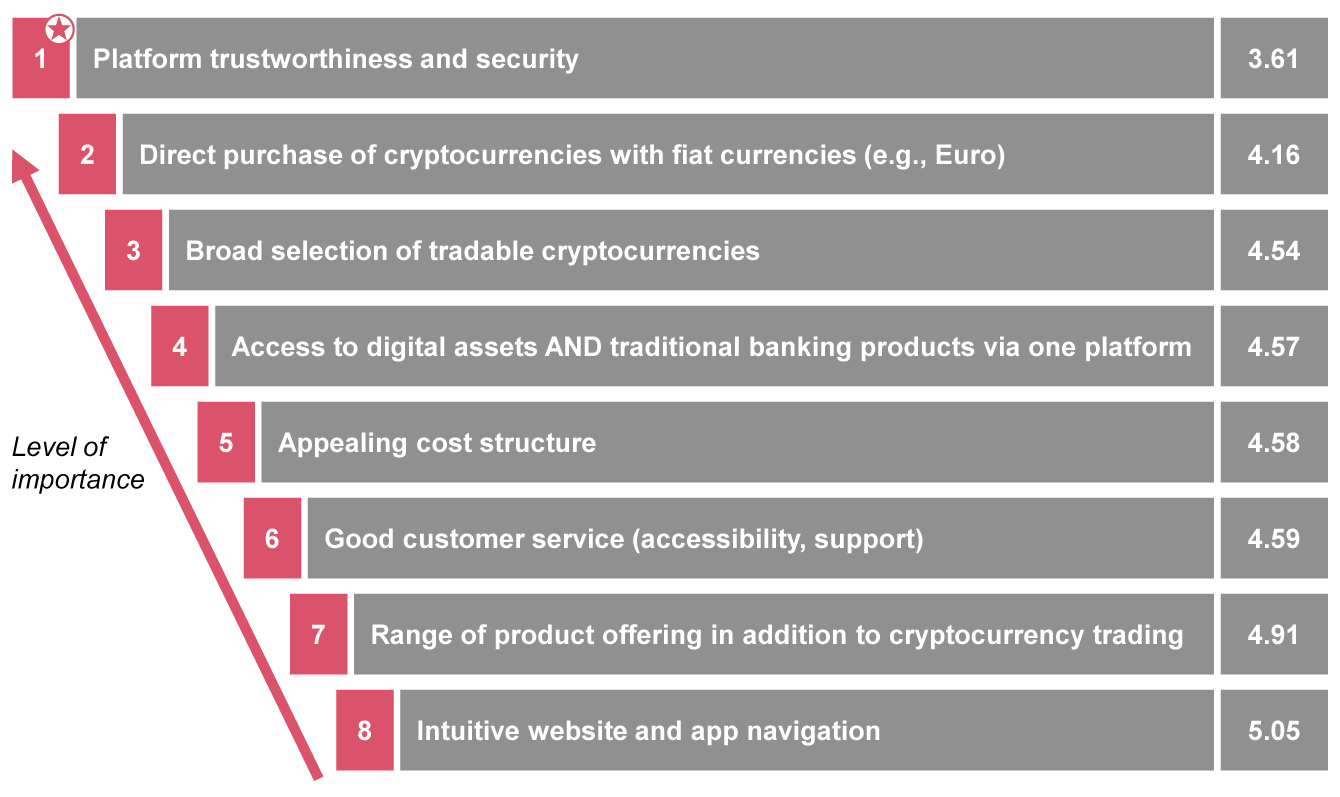
Imagine you are looking for a new trading platform to buy cryptocurrencies
3 Conclusion
What this means for financial services providers
The findings make the strategic imperative clear: banks and digital asset platforms need to look beyond pure crypto trading. Integrating stablecoin transfers and tokenized assets into existing platforms is becoming essential to remain relevant.
What remains true from previous editions
- Crypto investors are committed long-term believers, and the trend is intact
- These investors are generally attractive clients for banks
- Trading behavior of crypto investors is converging toward that of stock investors
- Crypto investors expect long-term relevance of digital assets for multiple reasons
- Availability of crypto offerings is a decisive factor in bank selection
What is new in 2026
- Tokenized assets are likely to meet significant demand from retail investors if adequate offerings are made available
- Stablecoins are increasingly cannibalizing conventional cross-border payments