Business into breach
Rethinking the private sector’s role in civil defense
Prof. Dr. Rainer Bernnat
Executive summary
- Europe and Germany face an increasingly complex threat landscape where cyber attacks, disinformation campaigns, and attacks on critical infrastructure occur simultaneously and reinforce each other, demanding coordinated resilience across state, economy, and society
- While numerous strategies and regulations exist, coherent implementation remains the core challenge, requiring private sector mobilization, cross-sector collaboration, and CEO-level commitment to resilience
- We recommend twelve measures across private sector, public sector, and society to build a robust and functionally interconnected overall system that does not treat state, economy, and society as separate entities but unites them for collective defense
- Short-term priorities include anchoring resilience in leadership structures, developing shared situational awareness through joint exercises, and empowering society as the first line of defense
Building collective resilience in a complex threat landscape
Europe is undergoing a period of intensifying geopolitical tensions, complex economic interdependencies, and accelerated technological changes. As a consequence, developing national and European resilience is a central security policy task. Germany, as Europe's economic and infrastructural hub, faces mounting pressure from hybrid threats including cyberattacks on businesses and government agencies, physical attacks on critical infrastructure, and disinformation campaigns designed to erode public trust in democratic processes.
Building resilience means preparing for disruptions while developing structures that allow the country to emerge stronger. This encompasses maintaining governmental functions, ensuring civil protection, securing essential services and supply chains for the population, and supporting armed forces readiness. Crucially, resilience is not solely a governmental task – it results from the interplay between state capability, economic stability, and social cohesion, requiring close coordination between public and private sectors.
The private sector plays a pivotal role as operator of critical infrastructure, key partner in national resilience, driver of innovation and proactive risk analysis, and facilitator of cross-border knowledge exchange. Both large corporations as well as small and medium-sized enterprises bring vital capabilities to the table. This report examines concrete approaches for cross-sectoral resilience strengthening in Germany, analyzing existing challenges and progress while identifying gaps and resilience measures needed to reinforce national adaptability across state, economy, and society – with particular emphasis on how companies can increase their own resilience while contributing to collective national defense.
Key challenges in the private sector, public sector, and society
New regulatory frameworks, technical safeguards, and emerging cooperation structures together create the foundation for strengthening resilience across state, economy, and civil society. Implementation requires careful evaluation of legal frameworks – from data protection to reservist obligations. The goal is clear: transitioning from reactive crisis management to strategically anchored, forward-looking resilience with defined responsibilities and cross-sector collaboration. To achieve this, the following key challenges must be addressed:
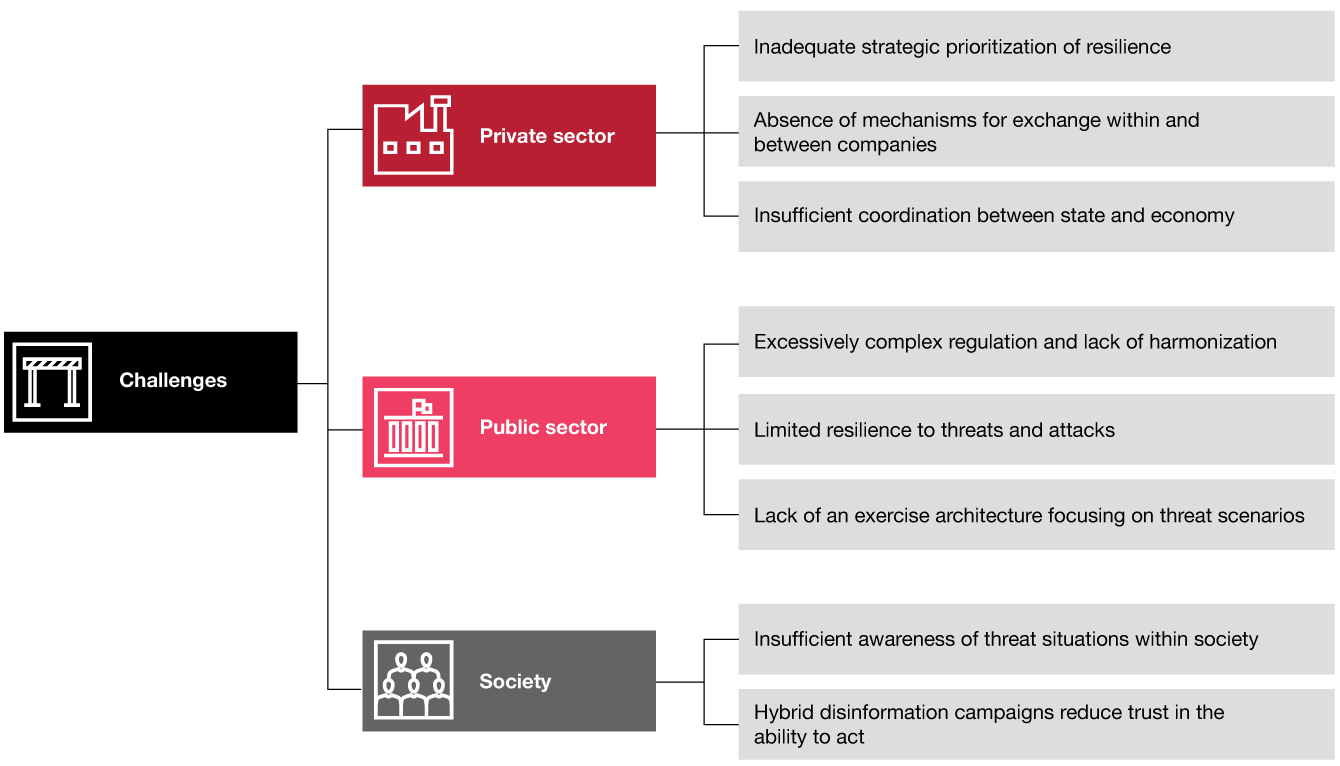
Key challenges
Twelve measures to strengthen resilience in the private sector, public sector, and society
To unlock the potential of a holistic cross-sector approach for increased resilience, twelve actionable approaches across private sector, public sector, and society are outlined below:
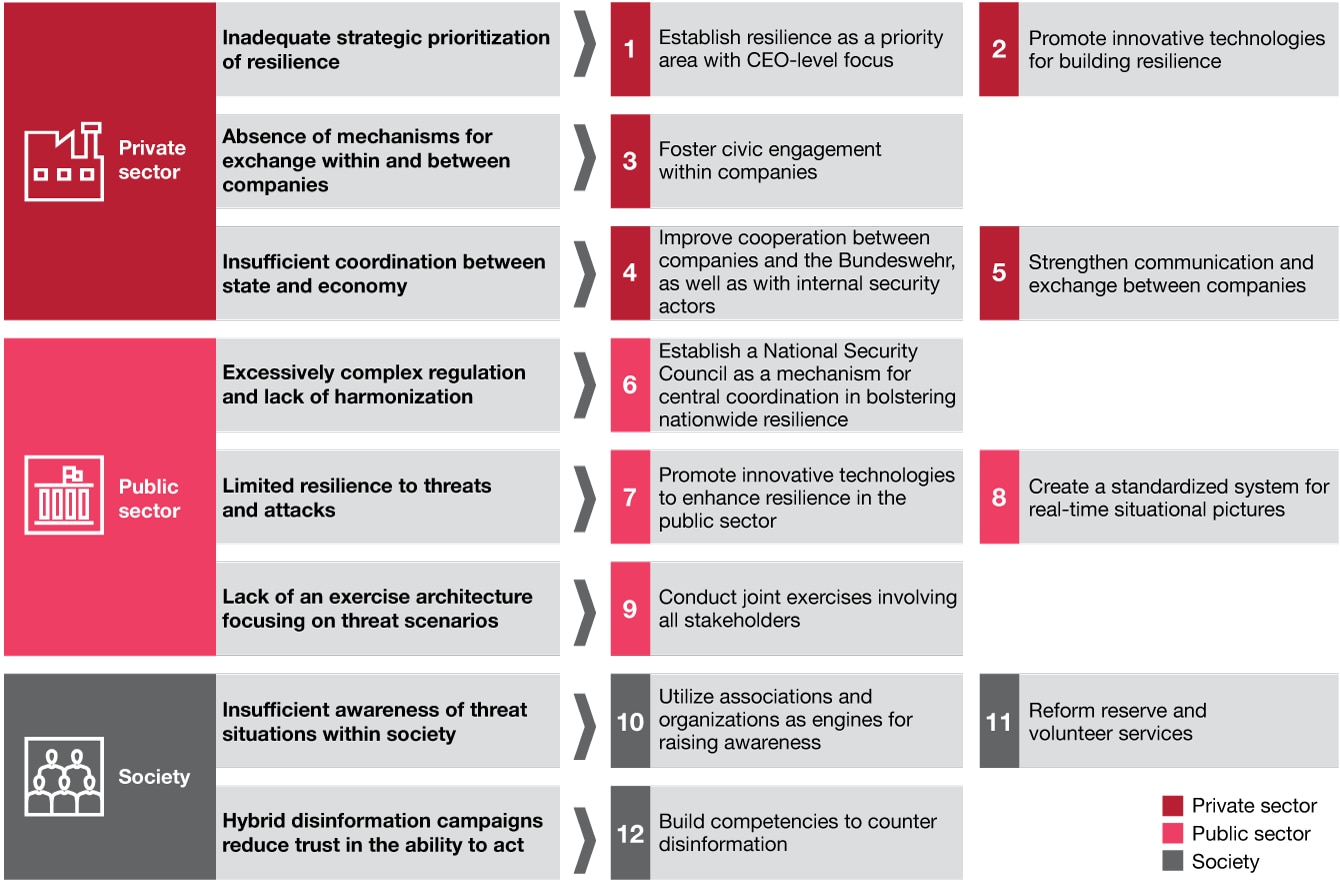
Challenges and actions for resilience
Turning national resilience into action: Priorities for short-term implementation
The effectiveness of resilience measures depends on consistent prioritization, coordination, and sustainable financing. Resilience is not achieved through isolated initiatives but through coordinated interaction between state, economy, and society. Government actors set strategic guidelines and provide coordination mechanisms, companies contribute through investments and innovation, and society forms the foundation on which resilience becomes effective in everyday life.
To accelerate implementation, companies should address six short-term priorities:
- Establish clear responsibilities and points of contact (private and public sector)
- Introduce rapid status assessment and prioritization of risks (private and public sector)
- Strengthen frameworks for crisis management and business continuity (private sector)
- Activate local and regional exchange formats (private sector)
- Raise awareness of employees and the population (private and public sector, society)
- Use existing financing and funding instruments (public sector)
A shared responsibility: Building resilience together
National resilience emerges only when economy, state, and society act in concert. The measures proposed in this report provide solid foundations – now they must be implemented consistently.
Lukas Lehmann, and Philipp Bauer co-authored this report.