The Next-Generation City
A strategic blueprint for the resilient, innovative, climate-positive and community-focused cities of future generations
Ruth Melches
Key findings
- This study reframes the conventional "Smart City" concept, proposing a human-centered "Next-Generation City" model that places people at the center, with technology serving as an enabler – anchored in ecological responsibility, social cohesion, and democratic governance
- Our holistic framework integrates six essential dimensions into a coherent system for future-proof cities: Sustainability, digital infrastructure, mobility, governance, social cohesion, and experience-driven design
- The business case demonstrates a positive long-term return: Annual investment costs are offset by financial savings and monetized social and ecological benefits, delivering substantial economic gains, CO2 reductions, and enhanced social well-being
1 Introduction
Challenges facing urban spaces today and tomorrow
A city that is resilient, inclusive, climate-positive, and innovative is not just a conceptual vision – it has become a necessity. Urban areas around the world are undergoing profound change driven by a complex mix of environmental, social, technological, and economic forces. According to the United Nations, the proportion of the global population living in urban areas is expected to rise from approximately 57% in 2023 to 68% by 2050. Alongside this urban population explosion, cities face fundamental demographic shifts, rapid technological advancement, and increasing demand from investors and the public for sustainable living models that improve living conditions.
While solutions vary by region, the core challenge is universal: the traditional “Smart City” paradigm – focused largely on technology – falls short. The future city must be human-centered and adaptive, with digital tools serving as enablers to deepen ecological stewardship, social cohesion, and democratic governance. This is what we call the “Next-Generation City”.
This study – a collaboration between Strategy& and TÜV Rheinland – outlines a strategic blueprint for transforming urban spaces into resilient, inclusive, and climate-positive ecosystems by 2050. The concept of the Next-Generation City is not utopian; it is a necessary and practical response to global challenges such as climate change, demographic shifts, resource scarcity, and digital transformation.
2 Vision and blueprint
A vision for the Next-Generation City
Moving beyond the traditional “Smart City” framework, we introduce a more comprehensive, human-centered concept: the “Next-Generation City“, a city that leverages technology within a broader framework of sustainable and community-oriented development.
While the Next-Generation City will not emerge overnight, its foundations are being laid today. We take the year 2050 as our strategic horizon – distant enough to allow structural change to take effect, yet near enough for today's decisions, technologies, and governance models to shape tomorrow's cities.
Our vision for the Next-Generation City is based on the principle that meaningful urban transformation must be holistic and innovative, with resilience, sustainability, and inclusion as interdependent pillars of future urban life. We see six core dimensions shaping the city of 2050: resources and sustainability, digitization and infrastructure, urban planning and mobility, social cohesion and cultural integration, governance and participation, and experience-driven design.
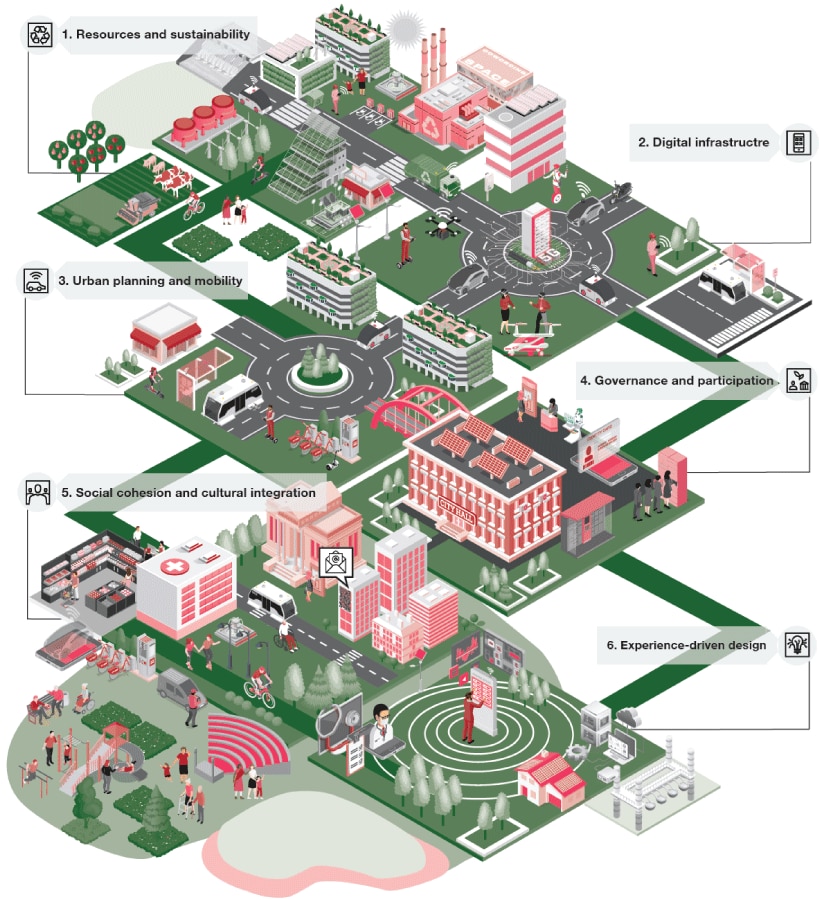
The following sections explore these six dimensions in depth:
3 Business case
The economic and social returns of Next-Generation Cities
By embracing a holistic approach that integrates technological innovation, environmental stewardship, and social inclusion, cities can unlock significant benefits while enhancing livability and democratic governance. The investments outlined create a virtuous cycle: they reduce operational costs, lower emissions, improve public health, and foster social cohesion – delivering both immediate gains and long-term urban vitality:
| 1. Operational cost savings | 2. Infrastructure and maintenance savings | 3. Public health and public sector efficiency | 4. Revenue generation and economic growth |
|---|---|---|---|
|
|
|
|
4 Key factors
Practical pathways for Next-Generation Cities
Overcoming common barriers to Next-Generation City initiatives requires more than technical innovation. It demands clear strategies, stable frameworks, and the ability to translate ambition into operational reality. Leading cities around the world demonstrate that successful urban transformation is built on a few robust cornerstones rather than countless isolated actions. Four factors stand out as particularly decisive in achieving lasting, scalable impact:
- Stable and transparent financing models: Clear, predictable funding strategies with defined responsibilities among public authorities, private partners, and other sources established early in the process
- Streamlined funding and regulatory processes: Simplified, accelerated access to funding and approvals through standardized procedures and dedicated administrative units for innovation projects
- Strong governance and cross-sector coordination: A central transformation office or clear governance structure integrating mobility, energy, digital infrastructure, and social policy from planning through execution
- Digital infrastructure and AI solutions: Robust digital foundations – high-capacity networks, shared data platforms, secure architectures – enabling scalable AI deployment across services. Interoperable systems, clear data governance, and cybersecurity allow cities to embed digital intelligence into operations while maintaining trust and adaptability
- Sustainable operational capacity and long-term management: Planning for operations and maintenance from day one – including stable funding, skilled personnel, and clear ownership – ensures initiatives remain functional and relevant over time
5 Conclusion
Stakeholder steps to accelerate the Next-Generation City
Transforming cities into future-proof ecosystems requires coordinated action across politics, business, and civil society. Each sector plays a distinct role in shaping urban futures that are resilient, inclusive, and climate-positive:
- Political institutions (municipalities, regional authorities, national governments) must provide enabling frameworks and strategic vision that support long-term urban transformation
- Business drives technological advancement, infrastructure development, and service innovation – bringing expertise, scalability, and investment capacity to urban transformation
- Civil society (residents, NGOs, community groups, cultural institutions) ensures development remains human-centered and socially inclusive, contributing lived experience, community resilience, and social innovation
The Next-Generation City extends far beyond technological infrastructure. Its success depends on multi-stakeholder collaboration: when politics provides vision and regulatory support, business delivers innovation and investment, and civil society contributes community insight and resilience, cities evolve into adaptive ecosystems capable of thriving amid global disruption.