AI-driven change and the next big thing
AI adoption and emerging technologies 2026
Dr. Christian Kaspar, Dr. Matthias Schlemmer, and Moritz Wächter
Executive summary
- Europe, and Germany in particular, further falls behind China and the US on both revenue uplift and cost reduction through AI, turning AI maturity into a question of economic competitiveness rather than technological capability
- In Germany, AI is currently moving beyond experimentation with single use cases, as 62% of CIOs expect AI to dominate strategic and operational decision-making within the next five years
- Yet real AI adoption remains shallow: only about one-third of CIOs have structurally embedded AI into core workflows and business operations, exposing a widening gap between ambition and execution
- The actual bottleneck is the data foundation: just 22% of organizations have the data readiness required to scale advanced AI use cases, making shared semantic models, robust data management, and sovereign infrastructure the decisive inflection point
- The next big thing besides AI will be composable resilience, built on cybersecurity and resilience (84%), privacy-enhancing technologies (80%), and and zero trust security (76%) enabled through portfolio discipline rather than single-vendor bets
1 Introduction
When AI moves from experimentation to the operating core
The AI conversation has quietly changed tone. For most of the past two years, leaders asked whether AI would deliver on its promise. Today, the question has shifted: how quickly can an organization reshape itself around a technology that is moving from the edge of the enterprise into its decision-making core? AI is no longer a feature layered onto existing processes – it is beginning to define how strategy is set, how operations run, and where competitive advantage is built or lost.
The tech leaders pulling ahead are those who have their data foundations ready, improve data access across the enterprise, and redesign operating models to let AI work at scale. For Europe, this has moved well beyond a technology debate; it has become a question of economic competitiveness and the ability to shape the next decade on our own terms.
To explore the state of AI-driven change in Germany, we asked 50 CIOs in Germany about their perspective on AI adaption, data readiness, digital sovereignty and the next big thing alongside AI. This report explores where AI-driven change is already creating measurable value, why so many AI initiatives are still stuck between pilot and scale, and how CIOs can build the foundations – technological, organizational, and human – to turn AI from an ambition into the operating core of the enterprise.
2 AI-adoption
The quiet illusion that defines AI adoption today
After years of AI experiments and investment, companies finally want to see real economic impact from AI. Here, PwC’s CEO survey shows how a global divide is opening up. China and the US lead the way in AI-driven revenue uplift and cost reduction, powered by faster innovation cycles and lighter regulatory frameworks. The EU and Germany, by contrast, are falling behind on both dimensions. This turns AI maturity into a question of economic competitiveness rather than technological capability.
AI impact on revenues and costs
At the same time, AI dominance is expected to be a near-term reality. More than 60% of CIOs expect AI-driven decision-making to dominate within the next five years, as AI evolves from a support function into a key component of strategic and operational decision-making across industries. Leading companies are already pursuing fully autonomous, AI-controlled plants that improve operational efficiency through real time data, and in finance, AI is hedging currency risks across global sales while lifting customer satisfaction through faster, more personalized customer service.
Yet structural integration remains the exception. Only around one-third of CIOs report having formalized their AI organization and structurally embedded AI into core workflows and business operations. The result is a widening gap between ambition and execution – the quiet illusion that defines AI adoption today.
3 Transformation gap
Why data management and organization decide the future of AI
Without a solid data foundation, AI remains stuck in pilot mode. The real constraint is not the technology itself, but the quality, structure, and accessibility of the data it runs on. Data access, data integration, and disciplined data management now separate leaders from laggards far more than model sophistication.

- Business meaning is trapped in code, dashboard or individual expertise
- Some domains are documented, but data meaning is inconsistent across systems
- Basic data standards exist, but lack a unified business logic
- Shared semantic models exist across all core business domains
- Knowledge graphs and AI-ready structures actively drive automation
- AI systems and autonomous agents are built around explicit machine-readable business meaning
AI-ready data acts as a catalyst that forces strategic positioning across three dimensions: geopolitics, risk, and innovation. And as AI moves from isolated use cases to enterprise-wide scale, capabilities can no longer sit in a central team. AI-fication at scale demands decentralized, embedded capabilities – and with them, a fundamental shift in business structure and how organizations are structured.
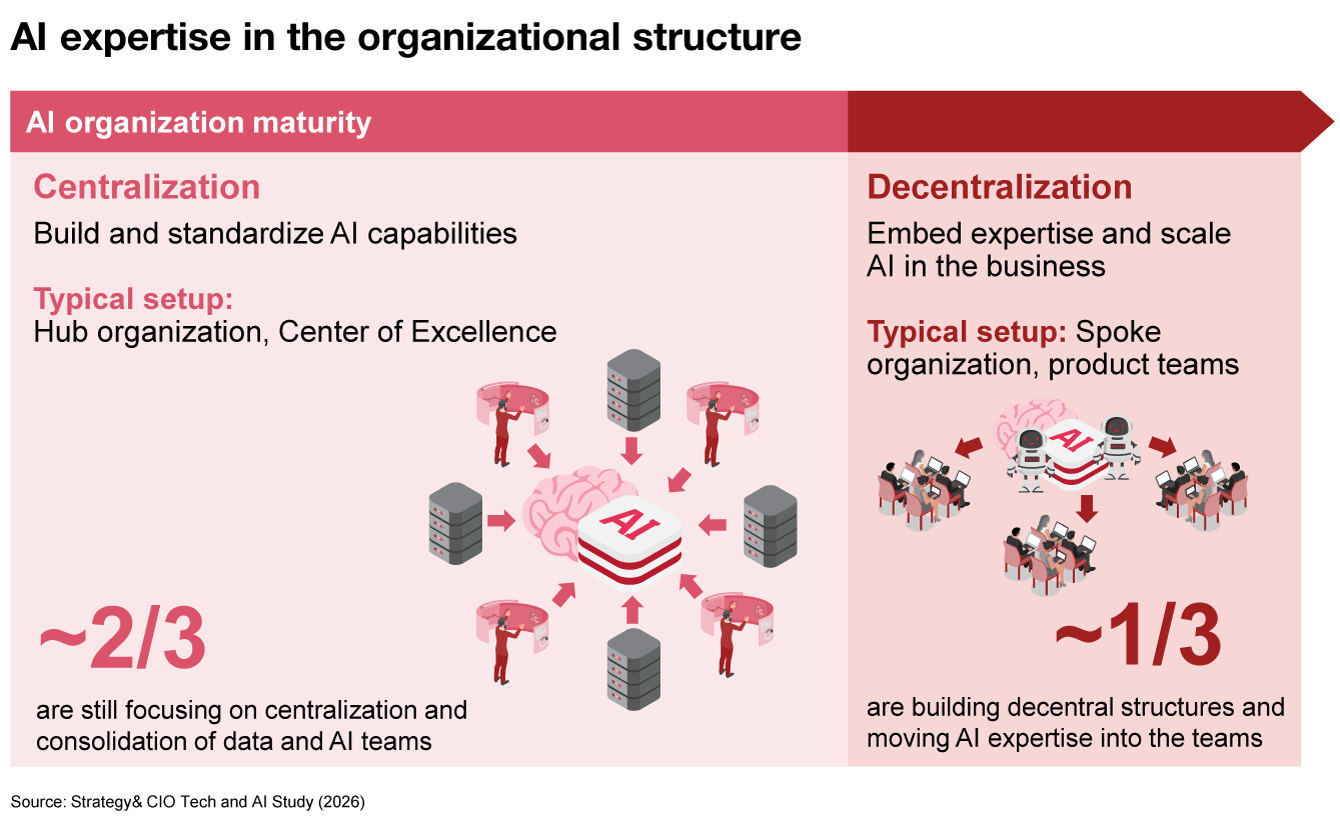
AI expertise in the organizational structure
4 Conclusion
Four moves to turn AI initiatives into competitive advantage
To scale AI's impact, strengthen data foundations, and build secure, future-proof operating models, CIOs should align their AI initiatives with clear business objectives through four decisive moves:
Franziska Meyer, Tobias Kalsbach, Sophie Kübler-Wachendorff, Jan-Hendrik Schmidt, and Franziska Henn have contributed to this report.