
The status quo of (bio)pharma innovation is challenged, requiring a new ecosystem view
Pharmaceutical companies are currently grappling with substantial challenges in their research and development (R&D) outcomes, primarily due to escalating costs and declining productivity. The cost associated with drug approval has surged from $2.78 billion to over $6.1 billion per drug.1 This financial strain has reduced R&D productivity for half of the top 20 PharmaCos, with historic lows in new drug approvals. Consequently, this is casting doubt on the sustainability of internal R&D. Acknowledging the limitations inherent in traditional R&D models, PharmaCos are broadening their innovation horizons by engaging more actively with external partners, notably biotech firms and academic institutions.
External innovation now dominates new approvals: Industry reporting highlights that nearly 70% of total sales of the top 20 PharmaCos come from externally-invented drugs (e.g., in-licensing, acquisitions or joint ventures) and were only brought to market by large PharmaCos, underscoring a pronounced shift towards external sourcing.2 Our analysis shows that the estimated share of NMEs developed externally (e.g., through in-licensing, acquisitions, and joint ventures) among new approvals will also rise to more than two-thirds of all new approvals between 2025 and 2029.3 As companies adjust their business models towards becoming “biotech-leveraged PharmaCos”, the strategic balance between external alliances and internal R&D investments becomes crucial for sustainable growth.4
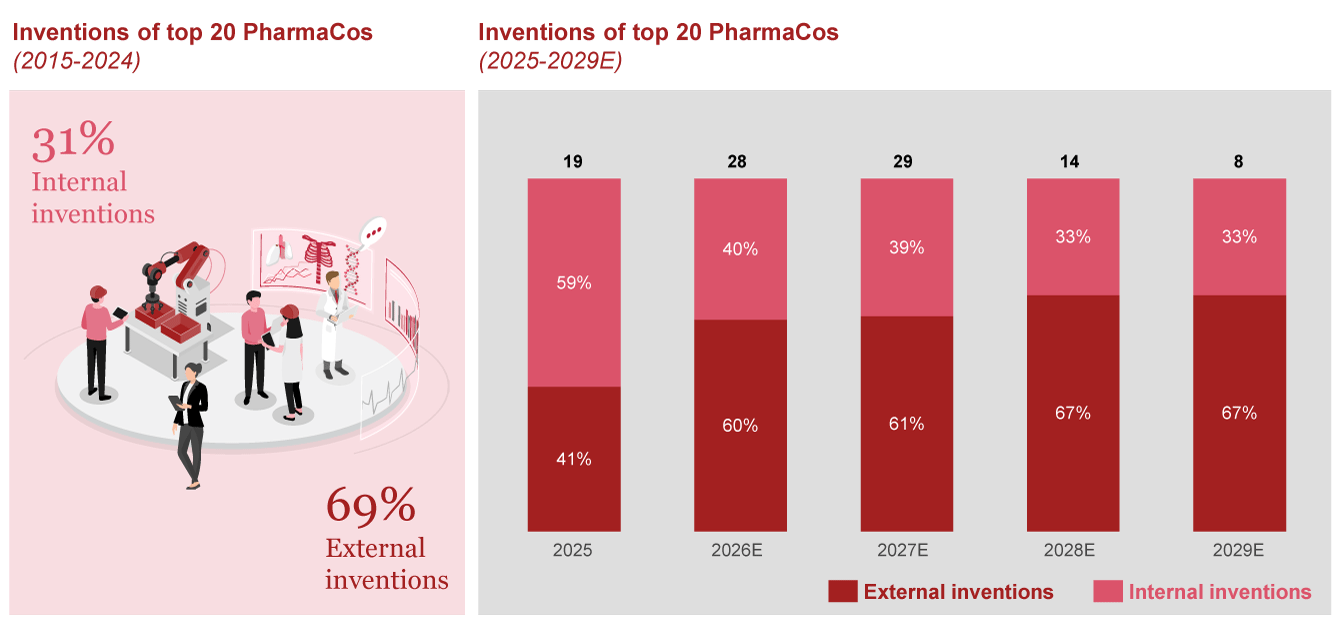
Inventions of top 20 PharmaCos
1 Analysis of pharma R&D productivity – a new perspective needed: https://www.sciencedirect.com/science/article/abs/pii/S1359644623002428
2 Diese Faktoren fördern milliardenschwere Übernahmen: https://www.handelsblatt.com/unternehmen/industrie/pharmaindustrie-diese-faktoren-foerdern-milliardenschwere-uebernahmen/100173484.html
3 Evaluate Ltd, Total Market: Sales by Strategy
4 Diese Faktoren fördern milliardenschwere Übernahmen: https://www.handelsblatt.com/unternehmen/industrie/pharmaindustrie-diese-faktoren-foerdern-milliardenschwere-uebernahmen/100173484.html
Stakeholders in pharma innovation ecosystems
Comprehending the varied perspectives of stakeholders is crucial for PharmaCos to effectively identify and achieve sustainable innovation through collaboration with external partners. Although the healthcare ecosystem encompasses a wide range of participants, the subset of stakeholders pivotal to developing innovative technologies is smaller. Critical potential innovation partners for large PharmaCos include biotech firms, small pharma players and academia. Additionally, venture capital firms and governmental/public institutions are increasingly emerging as important partners and enablers in driving innovation.
Below, we highlight the opportunities, pull factors, watchouts and recommended best practices for collaborating with these stakeholders in innovation sourcing.
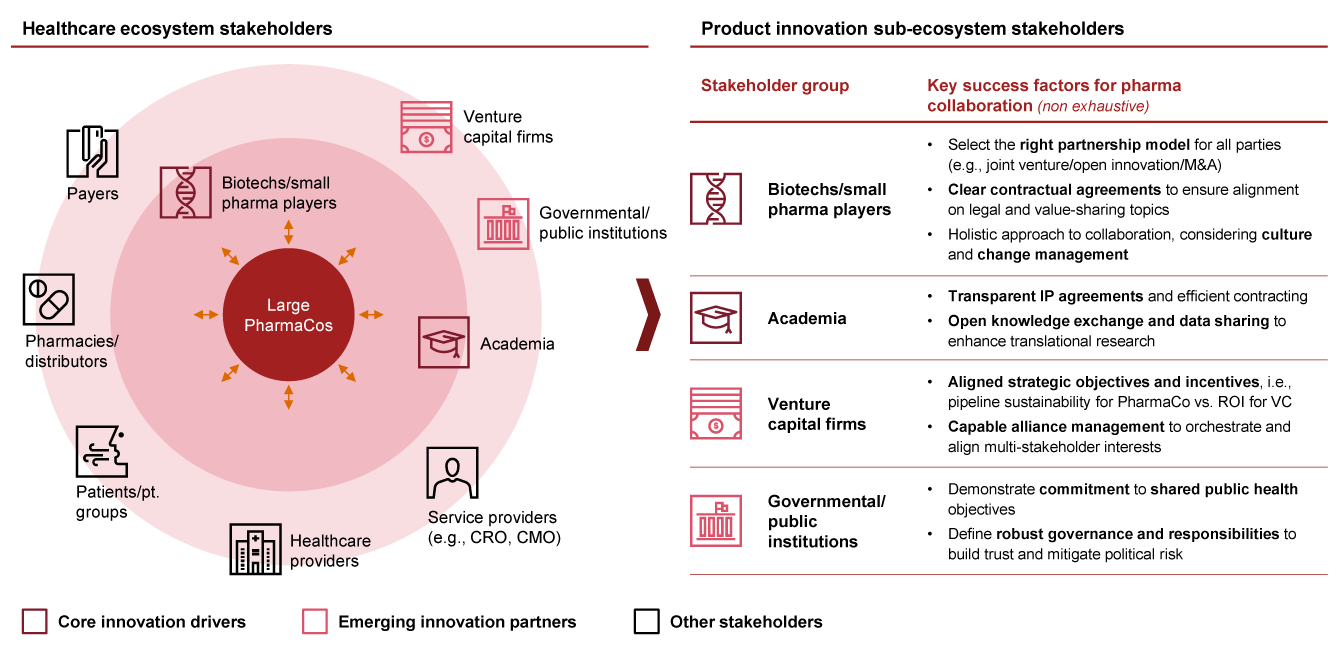
Healthcare and product innovation ecosystem stakeholders




Biotech and small pharma players
From the PharmaCo perspective, partnerships with biotech and small pharma companies offer major opportunities. They provide access to cutting‑edge science, including novel mechanisms of action and discovery technologies not available in‑house, strengthening pipeline quality by improving the overall probability of success across clinical portfolios. These collaborations also distribute financial and development risk. Combining the agility of smaller innovators with the scale and operational excellence of big pharma can accelerate development timelines and speed market entry. Additionally, partnerships enable strategic expansion into new therapeutic areas without requiring internal capability-building.
For biotech and small pharma companies, the pull factors are equally strong. Collaborations bring essential funding – both general and trial‑specific – as well as access to advanced infrastructure and experienced R&D teams. Big pharma’s regulatory expertise helps smaller firms navigate complex approval pathways. Co‑commercialization further allows biotech firms to leverage global marketing and distribution networks, expanding reach. Association with established PharmaCos also boosts credibility and opens doors to new partners and stakeholders.
However, several watchouts must be managed. Cultural and operational differences can hinder collaboration, with large organizations’ structured processes potentially clashing with biotechs’ flexibility. Talent flight is a key concern, as researchers are significantly more likely to leave post‑acquisition. Clear IP agreements are critical to prevent disputes, and deal terms – valuation, milestones, contracts – must be carefully negotiated to avoid overpaying for uncertain assets. Integrating biotech assets into existing pipelines also requires tailored operating models to unlock synergies.
To address these challenges, best‑practice models include strategic alliances, such as the Sanofi-Regeneron partnership on Dupixent, venture investment vehicles like the Novartis Venture Fund, and open innovation platforms such as J&J’s JLABS. Flexible, stage‑appropriate partnership structures with clearly defined roles and value‑sharing mechanisms help ensure alignment and long‑term success.
Academia
Academia is an increasingly attractive innovation source for PharmaCos, offering access to cutting edge mechanisms of action and advanced platforms. Academic partnerships are often long term and less transactional, and many PharmaCos now collaborate with leading universities and institutes in major biomedical hubs. Establishing these partnerships requires involvement across multiple PharmaCo functions – from global R&D (scientific partnerships, research, translational medicine) to local teams such as government affairs – given academia’s more complex stakeholder landscape compared to biotechs.
PharmaCos gain several opportunities. Academic institutions drive breakthrough science in early stage and “blue sky” fields, including technologies like mRNA vaccines. These partnerships diversify pipelines through complementary discovery approaches, often with lower funding requirements and longer scientific horizons. They also give PharmaCos access to a global talent pool, funneling highly-trained graduates and postdocs into industry roles.
Key pull factors for academia can be PharmaCos’ commitment to science driven collaboration, through prioritizing deep scientific exchange and regular interaction between researchers. Long-term partnerships require clear but uncomplicated contractual frameworks, with fair IP terms that allow academia to reclaim rights when appropriate. Some PharmaCos even establish research institutes within academic hubs, such as Novartis’ FMI in Basel.
However, watchouts exist. Academic institutions often operate in silos, lacking unified governance or a central industry contact. Data systems may be fragmented, with restrictive policies that hinder AI enabled innovation. Long-term contracts can also create tensions if not adapted as partnerships evolve.
Best practices include creating unified partnership leadership, selectively sharing infrastructure, using standardized legal frameworks (e.g., master research agreements), improving data interoperability, and establishing joint career pathways to support international talent and enhance mobility between academia and industry.
Governmental and public institutions
When we look beyond the core innovation stakeholders, governmental/public institutions are also growing in relevance. This stakeholder group mainly comprises biotech hub organizations, public research institutes, public funding sources and consortia/foundations for topics such as real-world evidence. Local, regional, and federal political stakeholders also have a sizeable role in a country’s biotech hubs.
Fruitful collaborations with biotech hubs require intensive interaction and co-creation involving public institutions and politics, with the biotech hub organization often acting as orchestrator. For example, a broad partnership with a public research institution can serve as the anchor for collaboration across an entire hub. Public funding sources frequently offer to match PharmaCo funding for the hub. When a consortium is deeply embedded within a hub, a PharmaCo can establish an additional strong link through this to the respective hub. To secure a large and impactful partnership with a hub, political involvement is essential. PharmaCos should therefore engage relevant political stakeholders and emphasize trilateral exchange between politics, public institutions, and themselves.
PharmaCos should focus on a limited number of comprehensive partnerships with biotech hubs, to ensure sufficient funding and collaboration time per selected hub and to maximize public visibility (e.g., AstraZeneca and its comprehensive partnership with the Cambridge hub). Given the multitude of stakeholders, a coordinated approach to interaction and partnership design with the respective hub is paramount.
Venture capital firms (VC)
Investors, and especially VCs, drive innovation in pharma and life sciences by providing funding and strategic guidance, accelerating the development and commercialization of novel therapies. For PharmaCos, VCs offer access to emerging technologies, help diversify risk, and enable strategic partnerships with biotech startups. These collaborations foster ecosystem synergies and support flexible investment models tailored to different stages of drug development.
VCs benefit from pharma’s global infrastructure, regulatory expertise, and market reach. Strategic co-creation allows them to shape early-stage ventures, while partnerships with pharma validate and de-risk their investments. Licensing deals and innovation through external partnerships have become valuable tools in overcoming sector challenges. Licensing mitigates risks related to patent expirations and competition, while strategic alliances help bridge innovation gaps and accelerate market entry. PharmaVCs bridge the gap between early innovation and large-scale commercialization. Their tailored investment strategies and scientific networks make them key players in advancing healthcare innovation.
To succeed, pharma must adopt strategic collaboration models, open innovation hubs, and flexible partnership strategies. Effective integration of external assets, along with thorough due diligence and goal alignment, is essential to navigate regulatory complexity and competitive pressures.
Pharma innovation archetypes and operating model implications
Executives must also think strategically about their “how” to successfully innovate with external partners. There is no single way to play; different circumstances (e.g., different companies, teams, technologies, or partners) may need tailored considerations.
We have identified five pivotal dimensions to characterize the role PharmaCos can play in innovation ecosystems:
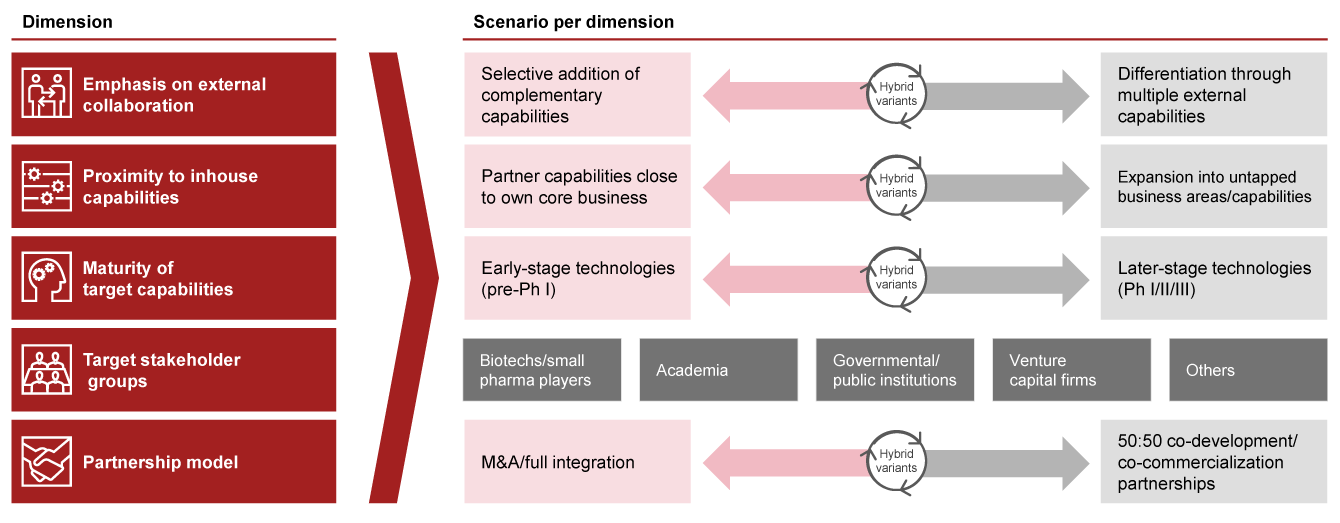
Key dimensions characterizing PharmaCos’ role in innovation ecosystems
A foundational question for pharma executives for their innovation strategy is: How strong should the emphasis on external capabilities be? A second, closely-related, strategic dimension defines how close the partner capabilities are to those of the PharmaCo itself – within its own area of expertise, or completely outside (e.g., indication scope, technology, geography). The third strategic question for PharmaCos considers the maturity of the target innovation, and how much development effort and risk compared to potential upside they are willing to invest. After identifying the scope of stakeholders to partner with as fourth strategic dimension, the final strategic decision relates to the partnership model, which is partly dependent on the type of stakeholder but can range between full integration and more “arm’s length” approach.
It is important to note that a single PharmaCo may not adhere strictly to a solitary archetype within each dimension, to retain a certain flexibility (e.g., for different therapeutic areas).
The right operating model is key to effectively managing innovation partnerships
In a PharmaCo, multiple different functions are involved in planning and executing collaboration, as well as interacting with ecosystem stakeholders. This can lead to inefficiencies, complexities and misalignments. The operating model therefore needs to evolve.
The scientific partnerships, BD&L, and alliance management functions should have the key roles in steering innovation collaboration. Multiple functions such as translational science, legal, and also the respective country affiliates should be significantly involved in supporting the partnerships concerned. In addition, various other functions should be selectively involved and provide input where required. From our client experience, it is important to establish these function tier levels to navigate internal and external stakeholder management. As a best practice, PharmaCos should consider creating an innovation ecosystem Center of Excellence (CoE) to orchestrate scientific partnerships, BD&L, and alliance management centrally under one umbrella.
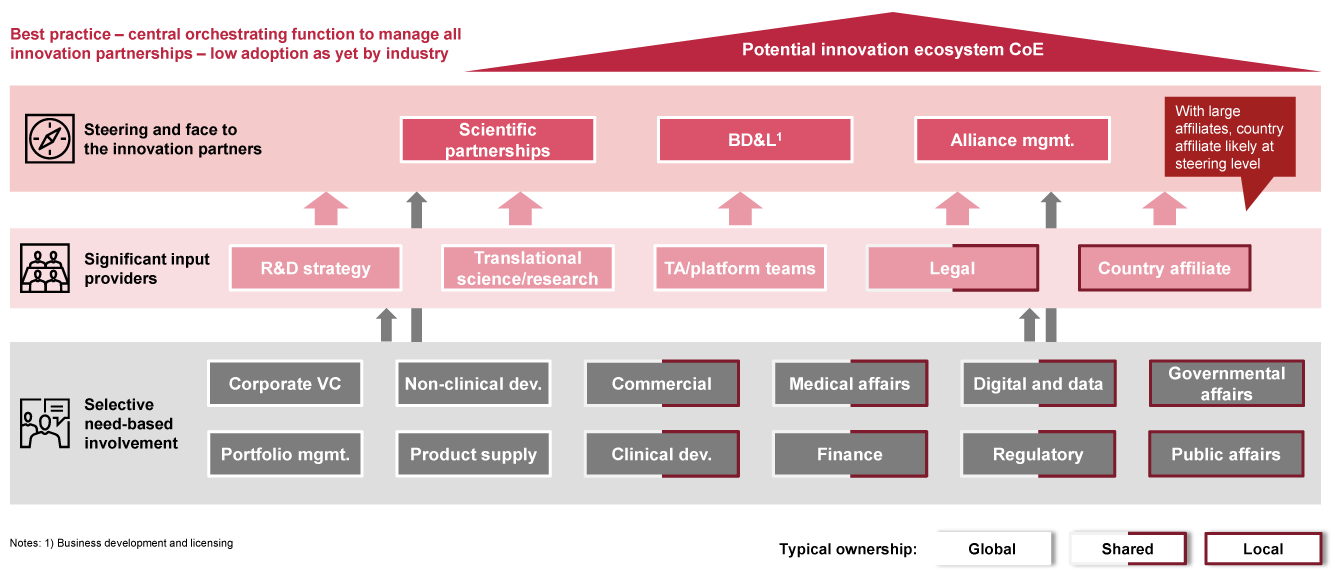
Key functions involved in orchestrating innovation partnerships
In practice, both the global level and the affiliate level play important roles in pharma innovation partnerships, because relationships with biomedical hubs are often stronger in the respective affiliates, who are involved in or even lead the actual execution of the partnerships most of the time. Accordingly, frequent alignment between the global and affiliate level is crucial – best-in-class PharmaCos have designed an operating model in which a few, select employees are involved in scientific partnerships, mainly in large countries, and work closely together with global representatives.
How patients benefit from orchestrated ecosystem innovation
The evolution of pharma innovation ecosystems is reshaping not only industry dynamics, but also the patient experience. By enabling broader therapeutic choice, faster access to innovation, greater personalization, improved real‑world safety, and more equitable and affordable care, these ecosystems deliver tangible patient benefits.5
Collaboration between PharmaCos, biotechs, academia, governmental/public institutions, and further stakeholders such as payers and patient groups expands the range of available therapies, particularly for areas of high unmet medical need. Pooling complementary expertise and resources accelerates development and regulatory approval, allowing patients earlier access to cutting‑edge treatments. This is especially visible in clinical trials, where multi‑stakeholder partnerships support earlier enrollment and access to investigational therapies, often years before traditional market availability.
Cross‑stakeholder data integration further enables more personalized care. Advances in biomarker science, early companion diagnostics, and AI‑driven patient stratification ensure therapies reach those most likely to benefit, improving outcomes while reducing ineffective treatment. Broader data sharing and post‑market evidence generation enhance real‑world safety, support better‑informed prescribing, and enable faster detection of rare adverse events.
Cell and gene therapies illustrate the power of these ecosystems. Many originated in academia, were de‑risked through biotech spin‑outs, and ultimately scaled via large‑pharma manufacturing and global distribution. This progression has enabled patients with rare, previously untreatable genetic diseases to access one‑time, potentially transformative therapies that would not have been viable within a single organization.
Finally, innovation ecosystems can improve affordability and access. Joint development with public institutions and payers supports pooled investment, aligned evidence requirements, and outcome‑based payment models. Greater involvement of patient groups in trial design and care pathways further promotes patient‑centric endpoints, higher adherence, and more inclusive studies that reflect real‑world populations.
5 Strategy& analysis
Now is the time to think about pharma innovation more broadly
Pharmaceutical innovation is at a crossroads: Escalating R&D costs, declining productivity, and the rise of external partnerships are reshaping how PharmaCos create value. With most new drugs now sourced externally, companies must master the art of multi-stakeholder collaboration to stay competitive. Success demands not only strategic agility, but also a deep understanding of complex internal and external stakeholder networks and flexible partnership models.
The time to act is now – patent expirations through 2030 among major PharmaCos represent roughly $200 billion of current revenue at risk, intensifying the need for new assets. By designing and implementing effective innovation ecosystem strategies, PharmaCos can thrive in this rapidly evolving landscape and harness the full potential of tomorrow’s collaborative opportunities.