
HR functions remain under sustained pressure to raise efficiency and reduce costs. A recent survey confirms these preoccupations:

The focus on automation, AI and digital spend shows that the pivot to AI is already underway, with the center of gravity shifting from on-demand content generation to autonomy and orchestration directly serving business goals, or as we call it: agentification of processes.
What is agentic AI, and why the hype?
Agentic AI refers to intelligent software that autonomously makes decisions and acts upon it to achieve defined goals without continuous human input. It operates around the clock, learns from its environment, and adapts as conditions change. In HR, its power lies in how it combines three complementary capability levers:
- Transactional automation accelerates repetitive, rule-based tasks to reduce errors and cost
- Strategic augmentation supports human decisions with real-time insights for better strategy and planning
- Central orchestration coordinates complex workflows across systems for real-time, end-to-end execution
Traditional generative tools excel at creating content from prompts but remain reactive. Agentic AI builds on these capabilities by adding goal-directed reasoning, persistent memory, and the ability to plan and execute actions within defined guardrails. In practice, this transforms static outputs into dynamic workflows that continuously learn from human feedback.
In recruiting, for instance, AI agents can plan searches, screen CVs, score candidates, schedule interviews, validate skills and draft recommendations for candidate selections, adapting shortlists based on recruiter feedback and continuously optimizing alignment with company goals and recruiter feedback. The shift is less about a setting up a single “super agent”, and more about carefully scaled individual agents for HR key areas that keep humans in the loop where judgment and context matters (e.g., talent sourcing, L&D, HR ticket resolution).
Because it unites autonomy, learning, and orchestration, agentic AI can already support more than 70% of HR processes. The gains vary by process: some primarily deliver FTE reduction, others improve service quality, and some unlock both.
- Up to 60% reduction in time-to-hire through autonomous resume screening and scheduling
- Around 45% decrease in payroll errors, improving compliance and employee satisfaction
- Approximately 30% improvement in talent retention predictions through AI-assisted analytics
- Up to 30% reduction in administrative HR costs and 200% faster response times, enhancing employee experience
Sources: PwCs Global People Process Framework Analysis (2025), Salesforce (2025), Moka (2025), Strategy& analysis
Strategically, grounding decisions around individual agents in a clear business case and measurable KPIs is critical to assess and deliver on ROI promises.
Why implementations stall, and how to avoid common pitfalls
Despite strong potential, successful implementations remain rare. Many organizations overlook fundamental questions until late in the build phase. Experts project that 40% of agentic AI projects will fail by 2027, mainly due to insufficient ROI. Companies face different underlying challenges:
- 52% cite unclear strategic objectives as a reason for failed or suboptimal projects
- 55% report a shortage of skilled personnel to develop and implement AI systems, while challenges also arise due to insufficient knowledge and motivation to use the available tools
- 65% lack the data infrastructure and IT foundation required for AI agents
- 60% struggle to integrate agentic AI into legacy IT environments, creating bottlenecks and added costs
Sources: Gartner (Agentic AI in HR), PwC (AI Agent Survey May 2025), PwC (Global Artificial Intelligence Study 2023), Strategy& analysis
The outcome is predictable: stalled pilots and difficulty scaling beyond isolated lighthouse cases. Our research shows that most companies ask the wrong question: “Which agent should we implement first?” The right question should be: “Which processes consume time, drive cost, or constrain performance?”
Therefore, we suggest answering three key questions early on to avoid the most frequent pitfalls.
Where are the true high-potential areas for agentic AI, and how will you assess them?
Identify pain points across the HR value chain that create cost, delay, or poor experience, and quantify their impact using dedicated KPIs such as time-to-fill, workforce coverage, new-hire ramp-up, retention, or employee satisfaction. A process-first lens surfaces high-value areas quickly.
How does agentic AI compare to other efficiency levers, and when is it justified?
Optimization can be realized with various efficiency levers (e.g., RPA, analytical AI, GenAI), and agentic AI is not necessarily the best solution to maximize ROI. The key discipline is matching solution complexity to efficiency potential, to confirm that the work truly requires multi-step reasoning and orchestration rather than straightforward automation.
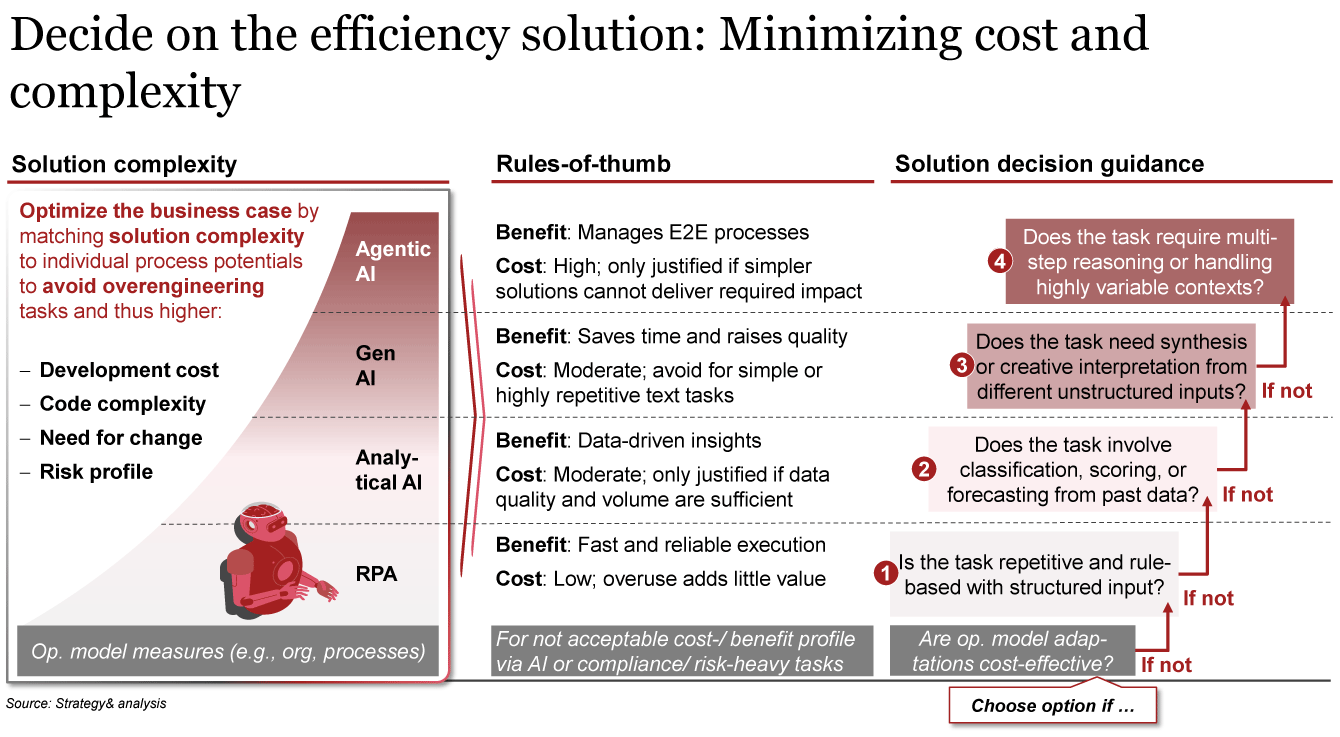
Where organizational maturity or compliance constraints make AI less suitable, process or operating model redesign is a critical enabler of successful (agentic) AI implementation.
How will you implement prioritized, fit-for-purpose agentic AI use cases in HR that can scale?
Especially when starting their agentic AI journey, organizations should start small to reduce risk and accelerate time to value. This means focusing on sub-processes instead of complex end-to-end workflows to contain complexity, and beginning with a pilot to prove impact and capture learnings before scaling what works.
Keep measurement tight and KPI-anchored. A single-use-case approach with clear checkpoints de-risks complexity and speeds up learning:
- Value ideation – Map pain points to HR strategy and build a business case against clear KPIs
- Feasibility check – Compare agentic AI to alternatives, validate compliance, and ensure data availability
- Solution design – Capture user requirements, draft a blueprint, build a proof of concept, and align on governance and security
- Production – Launch a right-sized MVP integrated into HR workflows and ready to scale
- Enablement – Provide training, risk management, and continuous data stewardship
When implemented correctly and scaled consistently, agentic AI can deliver tangible ROI fast.
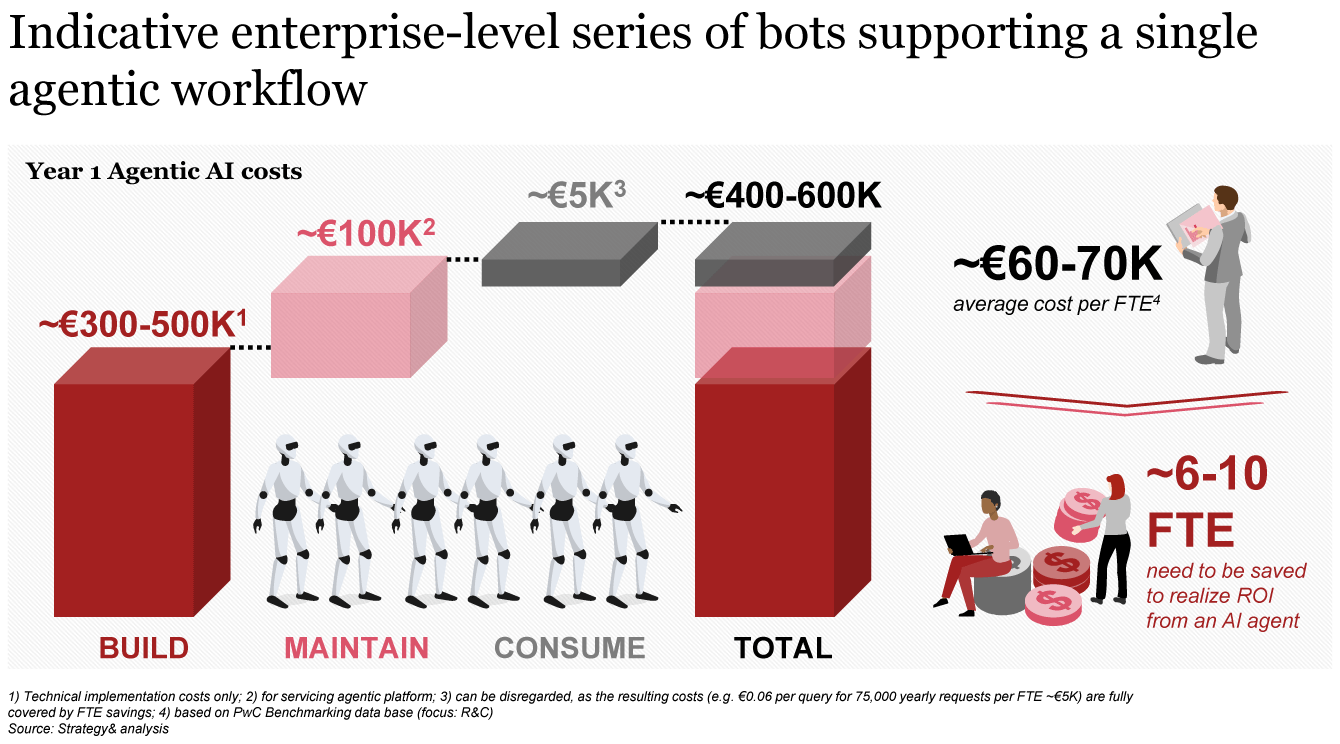
Agentic AI is not a monolith, and the subsequent build-versus-buy decision depends on strategic importance, customization needs, speed-to-value, expertise, and total cost of ownership. Where competitive advantage relies on proprietary data, building may be justified despite higher investment and longer timelines. In most other cases, out-of-the-box solutions can deliver quick wins, provided users are upskilled and prompting proficiency is established. The principle is fit-for-purpose, not most complex. Especially for early use cases, “buy” is usually best; only a clear competitive edge justifies “build.”
What good looks like in practice
Leading HR functions are already piloting focused agentic AI solutions that can be scaled to end-to-end workflows if successful.
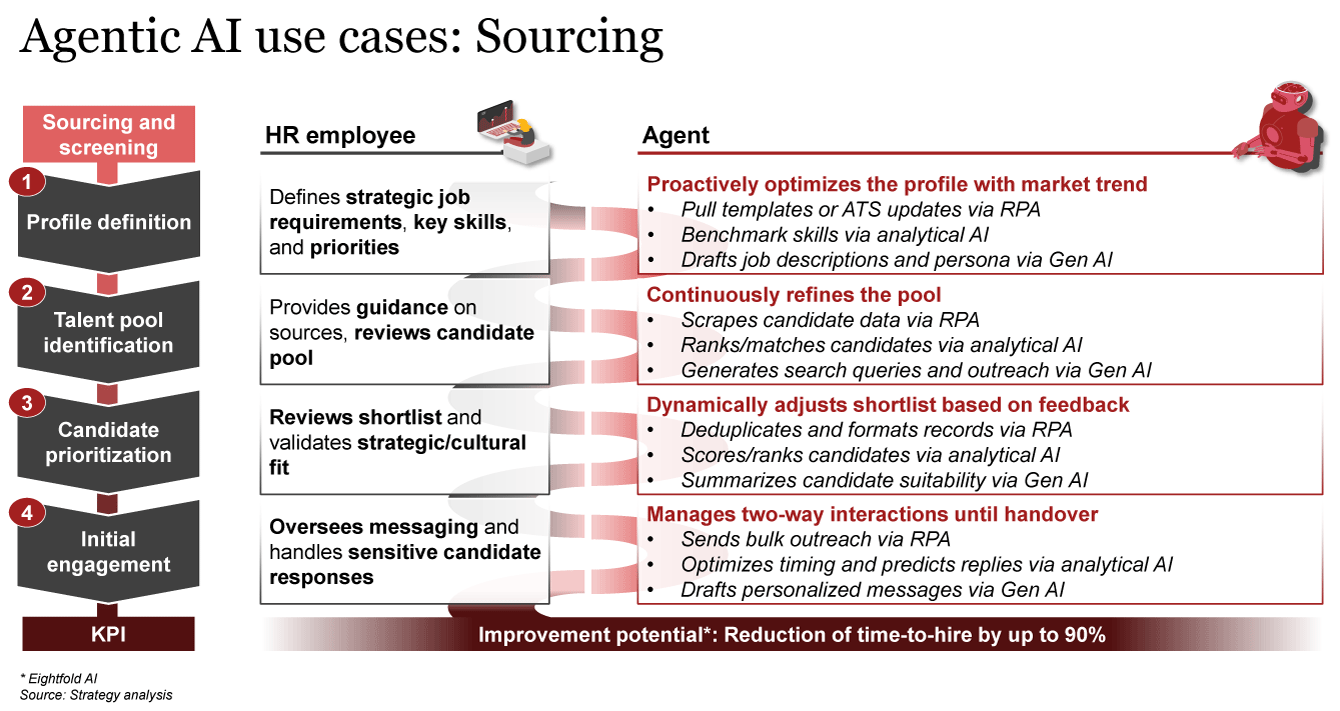
Foundations for enablement and the realities of scale
Turning pilots into enterprise-level value relies on three enabling foundations:
- People – Identify impacted roles, assess digital and AI literacy, anticipate resistance, and foster change champions. Role-specific training and transparent communication help teams understand the benefits and evolving task divisions as agents take on transactional work.
- Data and IT readiness – Validate required datasets, quality, and accessibility. Ensure infrastructure can host and scale agents, and establish data pipelines, interoperability, and monitoring.
- Risk guardrails – Define compliance requirements, mitigate sensitive data and bias risks, and plan for operational failures with auditability, explainability, and human-in-the-loop checkpoints to preserve trust.
As use cases grow, challenges around risk, skills, and collaboration intensify. With linear workflows giving way to agent-driven designs, HR operating models must stay flexible to adapt continuously.
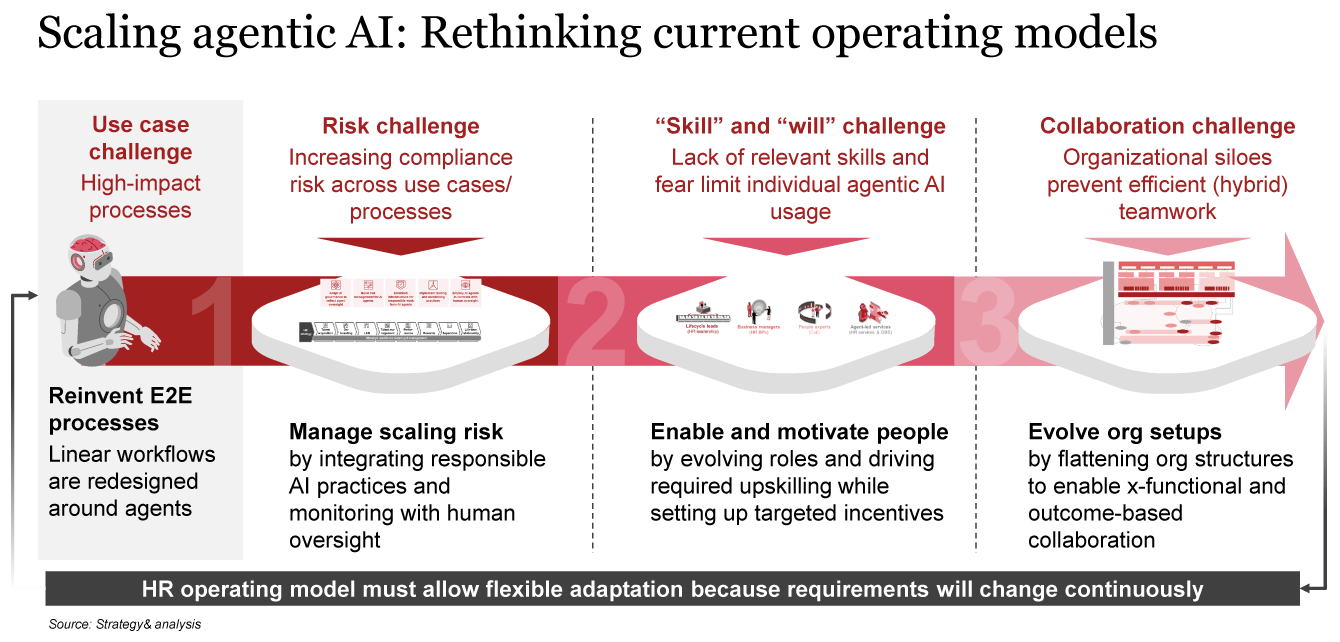
Crucially, scaling is not simply adding more individual use cases. It requires rethinking how HR work is organized, elevating roles and skills, flattening structures to enable cross-functional collaboration, and redesigning workflows around human judgment and agent capability.
Evolved HR can secure the benefits of agentic AI
Agentic AI can become a virtual HR efficiency engine, but only if implemented with discipline and scaled through an evolved operating model. Sustainable value starts with business outcomes and process pain points, applies the simplest effective lever for each task, proves impact quickly, and invests early in people, data/IT, and risk foundations. Where agentic AI is the lever, it can help manage E2E processes, compound efficiency, enrich the employee experience, and deliver a more agile HR function to enable the business at scale.
This article was co-authored by Niklas Frings.